
What we made.
What we tested.
What comes next.
Independent AI editorial reviews, separate $100 Meta and $70 Search pilots, and transparent revenue assumptions. No human expert endorsement or measured conversion success is implied.
Historical baseline scores — earlier editorial scope
Earlier content composite 8.0/10; market 6.3/10; economics 4.5/10. These earlier judgments are not current release certification. Content weights were 35% author, 45% literacy and 20% artifact; chosen weights and AI scores were not calibrated sales or learning predictions.
The thesis.
Sell a clearer parent–teacher decision process, supported by inspectable examples and print-ready records. The guide can save planning effort by connecting the learning goal, access arrangement, response, and next step. Its commercial value depends on whether buyers prefer that convenience to authoritative free alternatives.
The proposition is practical, not a new scientific discovery. The illustrated edition includes seven sources and a targeted update with relevant 2023, 2025 and 2026 publications. Proposed routines and starter passages have not been evaluated as an intervention.
Reviewed artifacts, with limits kept visible.
The illustrated guide has 99 pages, 16 explanatory figures and seven linked sources. The latest independent editorial round verified corrected examples and semantic table/navigation fixes. Ordinary scoped ebook publication has an editorial pass; all-parameters 9/10, accessibility certification and profitable demand have not been demonstrated. Audio completion and availability are reported separately below.
Current editorial round
EDITORIAL_PASS_WITH_DECLARED_LIMITS · 2026-11-14T04:23:07.072049+00:00
Editorial prepress PASS WITH DECLARED LIMITS. EE01–EE05 concrete defects fixed and reviewed. Parent changed-text-region visual review recorded. Subsequent palette-only contrast correction verified in current PDF/EPUB/HTML: text/geometry/manuscript/script/logo unchanged; all99pages rerendered and targeted final visualQA passed. This is not an all-parameters9, accessibility certification, efficacy validation, audio-performance or market-demand sign-off.
| Dimension | Current editorial judgment | Evidence and remaining limit |
|---|---|---|
| Completeness and scope honesty | 8.5/10 | Ten substantive chapters, original workbook,12reasonedquestion/answerpairs,4tools,16figures and7linkedreferences. Proposed routines and limited research coverage are explicit. Complete does not mean exhaustive research or validated intervention. |
| Claim discipline and research representation | 8.5/10 | Comparisons, populations, group versus individual limits, and finding/proposal distinction are consistently attached. This lane did not reappraise all full primary texts, so cannot certify exhaustive scientific accuracy. |
| Instructional accuracy and example traceability | 8.7/10 | Workbook keys agree with supplied passages; chapter8 now uses actual Mr.Ellis soundboards/looserail evidence and exactlook-back cue. |
| Instructional consistency and actionability | 8.5/10 | Canonical establish/compare/teach/transfer/review summary agrees with workbook session roles; actual novice use remains unobserved. |
| Developmental structure and prose economy | 7.8/10 | Readable progression from decisions to evidence, support and application. Repeated caveats/access-versus-decoding advice across chapters add length; further consolidation is possible without weakening boundaries. |
| Visual explanation and print legibility | 8.5/10 | Purposeful explanatory figure set, evidence chart includes uncertainty, inspected finalp65/68/90arelegible. This lane did not independently reinspect all99finalpageimages. |
| Navigation and cross-format integrity | 8.5/10 | 17PDFbookmarks, selectable text,15pageclearlylabeledsample,HTMLchapteranchors,EPUBnav/NCX,16figureexports. Actual e-reader runtime remains untested. |
| Accessibility | 7.5/10 | Four HTML/EPUB tables now have10scopedcolumnheaders; meaningfulfigurealttext andHTMLmain present. PDFuntagged; noactualscreen-readertest. |
| Sample-to-product representation | 8.5/10 | 15pages include allChapter1 plus decision/recordtools andsources; original pagination explicitly disclosed. The sample cannot establish buyer willingness to pay. |
| Publication validation integrity | 8.0/10 | Two actualartifactreview rounds andhashes; concretefaultsfixed andverified. Finalchanged-pagevisualinspection andreader/accessibility tests separate. |
AI editorial judgments for the stated artifact scope; no forced average, human expert endorsement or sales prediction. This round did not perform a full primary-source appraisal, assistive-technology test, audio listening review or buyer study.
Selected generative audiobook · independent round 3
SCRIPT_TECHNICAL_AND_SAMPLE_PASS; FULL_AUDITORY_RATINGS_UNASSESSED · 2026-11-14T03:59:06.447290+00:00
Independent complete12-track/54 SSML text comparison; actual 54-chunk engine/voice/hash checks; ffprobe and complete decoding of final masters/chapters; whole-MP3 and repaired-M4B independent integrated loudness/true-peak scans; twelve master/chapter waveform navigation spotchecks; two actual preview source-waveform comparisons/decodes/loudness; five actual source-bound AWS ASR transcripts and clip hashes/waveform provenance. No billed services or subjective-listening claims.
| Audio dimension | Scoped judgment | Evidence and limit |
|---|---|---|
| Complete spoken-script coverage | 9.0/10 | All 12 complete track texts and 54 valid SSML chunks independently match final 19,732-word script; actual 54 source-audio hashes match GENERATIVE/Ruth manifest. Includes 12 questions/keys,16 figure descriptions and all four exact printable-tool walkthroughs. Script completeness does not certify every rendered word. |
| Chapter structure and file navigation | 9.0/10 | Twelve separate MP3s and twelve named contiguous markers in both complete formats, start 0 / end 8640.768 seconds. Every title matches plan. Eight-second waveform spotchecks at all 12 markers correlate with corresponding chapter >=0.98046, supporting order; no third-party-player usability certification. |
| Sample-to-production fidelity | 9.0/10 | Selected GENERATIVE/Ruth actual chapter excerpts:89.470454 seconds content and75.88 seconds story; source-waveform correlations 0.99997245/0.99997606, exact hashes and crop ranges verified. Canonical sample is content excerpt. Website wiring is outside this local audit. |
| Technical direct-download encoding and completeness | 9.0/10 | Full MP3/M4B and12 separate chapter MP3s decode; current cover embedded in full formats; whole MP3 -18.60LUFS/-3.82dBTP, independently repaired M4B -18.15LUFS/-3.49dBTP. No ACX certification. |
| Research qualifications and workbook neutrality in script | 9.0/10 | Script preserves uncertainty/group-versus-individual bounds, fictional examples, nonvalidated workbook/tool warnings and nonleading question/answer separation. Five actual bounded ASR clips support central retained meaning; this is not an independent re-verification of underlying studies or complete spoken transcription. |
| Emotion-direction appropriateness | 8.5/10 | Silent directions distinguish qualified research, restrained fiction, neutral questions and answer-key pauses; GENERATIVE production uses supported rate/paragraph/pause controls and matches user-selected A/B engine/cadence. Full performance of intended nuance has not been listened to independently. |
| Actual vocal emotion, naturalness and engagement | Not assessed | Human user listened to a same-text130-word A/B and selected GENERATIVE. This is sample preference evidence; reviewer has no successful auditory ingestion/evaluation of final whole book. ASR and LUFS cannot establish emotional 9. |
| Full-book pronunciation and auditory intelligibility | Not assessed | Five actual source-bound ASR spotchecks retain central meanings; unresolved hid/hit, cupboard/covered and short answer-key cue ambiguity may be ASR errors. No full-book listening or research-name pronunciation certification. |
Technical and script scores are scoped judgments. Actual full-book emotion, naturalness and pronunciation are not assigned an invented score; no all-parameters 9/10 claim follows.
Current market and sales-evidence round
PASS_SCOPED_LIVE_PDF_MP3_BUNDLE_OFFER · 2026-11-14T04:05:57.335182+00:00
Actual live buyer flow has two source-matched selected-generative excerpts/transcripts, exact worked proof before paid CTA, clear12USD PDF+MP3 entitlement/help and material APA AI counterevidence/limits. Private audio technical delivery is verified separately. This is a scoped offer/copy pass, not audio-emotion, sales, buyer usability or profitable-acquisition validation.
| Dimension | Current judgment |
|---|---|
| Category demand evidence | 8/10 |
| Audience job clarity | 8/10 |
| Differentiation against free alternatives | 7.5/10 |
| Public sample sales fit | 8.5/10 |
| Offer scope honesty | 8.5/10 |
| Book specific willingness to pay | Not demonstrated |
| Profitable acquisition evidence | Not demonstrated |
Final independent live readback verified the selected-generative PDF+MP3 bundle, both actual master previews/transcripts, worked example, exact offer/help and APA counterevidence. Purchases and profitable acquisition remain unobserved.
Open evidence gates
| Parameter | Current gap | Evidence needed |
|---|---|---|
| Usability | No representative novice-use study | Observe consenting target adults using a tool and identifying the paid offer; revise recurring failures. |
| Accessibility | PDF untagged; real reader tests pending | EPUBCheck5.4 reports zero errors and warnings for the final EPUB; actual e-reader, keyboard and screen-reader checks remain open. |
| Narration | Complete master; bundle enabled | Actual full-human listening and subjective emotional-performance evaluation remain separate; technical completion does not earn 9/10. |
| Market and economics | No genuine paid orders or observed acquisition contribution | Observe actual buyers under the user-authorized capped pilot, verify fulfillment and consented Purchase, and reconcile real costs and refunds. |
| Native execution | Council returned zero completed reviews | A responding authorized model route and actual book-specific council reviews; preserve dissent and failures. |
Native research enrichment and ideation timed out. Native Firecrawl fetched the three new primary sources, while irrelevant discovery bundles were rejected. The native four-seat council used two distinct Gemini aliases and returned an evaluation error with zero reviews; image-input review also returned no responses. An error sentinel is not a book score or approval.
Earlier nine-dimension artifact assessment — historical scope
Independent bounded artifact review of 16 figures / 14 representative pages; native council 0completed reviews. Scores do not establish a whole-product average.
- Dimension: Content accuracyScore: 8.5/10Evidence: Chapters02/06 and checked numerical/current claims agree with primary sources; populations, comparisons, outcomes and causal limits remain attached. This is a bounded independent check, not a complete peer review. Next: Complete claim/source and answer-key review across final99 pages; resolve any changed context after layout edits.
- Dimension: Evidence currencyScore: 8/10Evidence: 2023 pacing,2025 digital/print and2026 Taiwan TTS work are present with correct distinctions. Search is bounded; full subscription texts and exhaustive risk-of-bias appraisal were not reviewed. Next: Document reproducible query/date/inclusion protocol and appraisal; obtain full subscription sources if making claims beyond their abstracts.
- Dimension: Practical utilityScore: 7.5/10Evidence: Two original passages, six questions each, reasoned keys, worked examples and reusable observation tools make the book actionable. No independent novice usability or learning-outcome observation; Figure15 supplies visual help before two questions. Next: Observe at least5 representative novice adults using a passage, key and decision form; record errors/completion time and revise recurring failures. This is a pragmatic pilot, not validation of learning efficacy.
- Dimension: Visual explanationScore: 8.5/10Evidence: All16 purposeful figures inspected; coherent readable styling; Figure3 accurately plots empirical effect estimates and uncertainty. Some repeated three-box grammar, duplicated titles and the rain-system vessel/tap could be improved. Next: Complete final99-page layout pass; verify current16 figure hashes, labels at print scale, captions and equal-information text descriptions. Review any rain-diagram support effects on questions.
- Dimension: AccessibilityScore: 6.5/10Evidence: Validation reports16 HTML/EPUB descriptions, selectable PDF text and17 bookmarks. PDF remains untagged; no independent keyboard, screen-reader, reading-order or measured-contrast audit in this lane. Next: Check semantic HTML/EPUB with an EPUB validator, keyboard and representative screen reader; measure contrast, reading order and PDF tagging. Untagged PDF is not accessibility certified.
- Dimension: Narration usabilityScore: Not assessedEvidence: No audio was listened to in this artifact lane. Do not infer pronunciation, spoken-figure completeness, chapter-navigation quality or actual listening usability from print files. Next: Listen to final actual audio, inspect chapter navigation and transcript alignment, pronounce research names correctly and describe every meaningful visual; no audio score inferred from print.
- Dimension: Market fitScore: Not independently demonstratedEvidence: Parent/educator job is specific and practical value is plausible; no observed willingness to pay, purchaser interviews or conversion evidence was reviewed in this lane. Next: Interview intended adult buyers and measure observed sample-to-purchase behavior; specify uncertainty. A plausible audience/job is a hypothesis.
- Dimension: EconomicsScore: Not independently demonstratedEvidence: No observed attributable acquisition or contribution data supplied to this artifact review. A revenue forecast and configured checkout cannot establish profitable demand. Next: Verify actual merchant tariff and completed paid fulfillment, then observe attributable costs, refunds and net contribution;100USD pilot cannot guarantee stable profitable demand.
- Dimension: Execution integrityScore: 7/10Evidence: Validation records actual limits and component evidence. Native council returned ESCALATE/EVALUATION_ERROR with zero completed reviewers; native vision responses are empty. Four named council seats map to only two Gemini aliases. Independent file inspection supplies separate evidence, not retroactive native approval. Next: Repair model route, run actual book-specific native council and current image-input review; preserve failures/dissent and independently verify final transaction and artifact checks.
Released artifacts. Open commercial questions.
SCOPED_FINAL_EBOOK_AND_AUDIO_PRODUCTION_PASS; OWNER_AUTHORIZED_100USD_PILOT_CURRENT_CREATIVES_ACTIVE; ALL_9_AND_EMPIRICAL_SALES_NOT_ESTABLISHED · 2026-11-14T04:36:07.120321+00:00
Preserve the actual specialist scores and evidence limits; do not average observed artifact quality with missing market or auditory data. A null score means unassessed, not zero. This is a council of agent review roles, not evidence that separate model vendors independently approved the book. Native model-council execution failures remain failures.
Actual browser checks at 2026-11-14T04:09:31.336402+00:00 played both selected-generative excerpts without an audio error. The 390-pixel mobile viewport had no horizontal overflow. Production PayPal name, number, expiry and CVV fields rendered in Chrome and the in-app browser for the tested eligible sessions. No payment was submitted: paid capture, buyer fulfillment and a genuine Purchase event remain unperformed.
Campaign readback: Meta campaign ACTIVE; ad set ACTIVE; ad 1: PAUSED, ad 2: ACTIVE, ad 3: ACTIVE, ad 4: ACTIVE. Checked 2026-11-15T19:14:39.546136+00:00. One shared $100 Meta pilot; Performance checked 2026-11-15T19:08:55.349591+00:00: Meta reported $24.54 spend, 993 impressions, 13 all-clicks and 8 outbound click(s). Observed outbound CPC: $3.07; this small sample does not establish stable performance. No paid purchase or profitable ROAS established.. One $100 campaign cap and one shared $100 lifetime ad-set allocation cover the same pilot, not $200. Flight: 14–21 November 2026, 04:13:26 UTC (13–20 November, 10:13:26 p.m. Chicago). Latest read-only Insights at 2026-11-15T19:14:39.546136+00:00: Performance checked 2026-11-15T19:08:55.349591+00:00: Meta reported $24.54 spend, 993 impressions, 13 all-clicks and 8 outbound click(s). Observed outbound CPC: $3.07; this small sample does not establish stable performance. No paid purchase or profitable ROAS established. The separate Google Search pilot has a $70 total cap for November 14–20, Pacific time; its $10 planned daily average is not a daily hard cap. The earlier bounded monitoring window is complete; no continuing background monitor is deployed. The $0.25 outbound CPC target is not a bid cap or promise. Manual review checkpoints are not deployed monitoring automation.
Read the public acceptance evidence. Earlier commercial reviews retain their original timestamps; this later platform readback supplies the activation update.
Earlier narration auditions — comparison history
Two readings. You can hear the difference.
Both samples read the same 130-word excerpt from The Blue Chalk Line. The expressive generative reading has been chosen for the final audiobook. The full generative master is technically complete; current offer availability is shown on the book page. These are short audition excerpts, not full-book files.
Same exact book words; engine AND supported cadence differ. This is an audition choice, not an isolated causal test of engine quality. Both normalized to same listening target. Actual emotion still needs listening.
Read the exact shared excerpt
“Could I just run across?” she asked. “I hardly weigh anything.”
Mr. Ellis lifted one end of a wooden rail. A nail slid out and landed beside his shoe. “The boards underneath are sound,” he said, “but this rail is loose. Someone could lean on it without noticing.”
Nia looked at the pond. The water was shallow near the bank, but she knew the bridge crossed a deeper channel in the middle. She put the windmill carefully inside her bag and turned toward the long path.
Then a gust blew the cardboard sign flat. A delivery rider came around the library corner, looking at the boxes strapped to his bicycle. The blue line was almost hidden beneath a scatter of leaves. Mr. Ellis was holding the rail with both hands.
Judge clarity, pacing, dialogue and whether the reading leaves room for your own interpretation. No emotional-quality score or buyer preference is assumed.
No, the entire native pipeline did not run.
Native PDF composition and EPUB/HTML/TXT export helpers ran. The 99-page illustrated PDF and its 16-figure reflowable editions use local adapters. Manuscript production, semantic layout, navigation, and visual QA used editorial equivalents. The latest research, ideation, council and narration work is separately recorded in the upgrade evidence. Native cloud drafting, translation, marketplace submission and native Google Ads stages have not run. Separate marketplace uploads are reported below. A separate Google Ads API integration created and enabled the authorized $70 total Search pilot for November 14–20, Pacific time; that is not a completed native pipeline stage.
The code logs phases 0–24; its “22-phase” docstring is stale. The current ledger below records later attempts and blockers; the original baseline is retained in a closed archive. Optional stages are identified separately rather than counted as failures.
Current execution ledger
| Phase | Latest status | Evidence and boundary |
|---|---|---|
| 0. Niche discovery | optional not run | book.py:1893; absent from the artifact build entry point No native discovery, trend research, or scored niche selection was run. |
| 1. Brief validation | editorial equivalent | manuscript-complete.json title/subtitle; builder constants The editorial brief is an equivalent input, not the pipeline validator or council. |
| 2. Research enrichment | Native attempted; editorial research delivered | Native enrichment timed out. Firecrawl fetched three verified primary additions; irrelevant discovery output was rejected. Bounded editorial verification supplied the accepted claims. |
| 3. Outline | editorial equivalent | Eleven structured chapter JSON files: ten chapters plus a practical workbook Curated chapter structure; no BookOutliner or its approval workflow. |
| 4. Title generation | editorial equivalent | Listening with Purpose title and chapter headings in manuscript-complete.json Editorial title selection; no native title-generation model or council. |
| 5. Chapter writing | editorial equivalent | Chapters01–11; 18,930 words in the final PDF including ancillary matter AI-assisted specialist drafting; not FirstDraftWriter within EBookPipeline.generate. |
| 6. Style editing | editorial equivalent | Revised chapter files and editorial review context Editorial revision; no native style editor execution or score proof. |
| 7. Clarity editing | editorial equivalent | Revised chapters07,08,10 and prose in the final artifact Editorial revision; no native clarity surgeon execution. |
| 8. Content review | Independent editorial rounds completed | Latest artifact round verified corrections to chapter 8 examples, session-plan consistency and semantic HTML/EPUB markup. Scope limits remain declared. |
| 9. Visual planning | Editorial visual plan implemented | Sixteen purposeful figure specifications and code-drawn explanations are implemented; native ideation timed out. |
| 10. Comic panel writing | optional not run | book.py:2526; no comic requested Not applicable to this prose title; current accepted ebook types also reject comic_book/graphic_novel. |
| 11. Cover design | local adapter | build_complete.py:Cover draws typeset title, original book/audio motifs, and the official logo No cover image-generation service was exercised. The delivered cover is deterministic local artwork. |
| 12. Illustration generation | Code-drawn figures; native image generation not run | Sixteen original explanatory figures. No generated-image model is credited with drawing them. |
| 13. Comic composition | optional not run | book.py:2700; no comic requested Not applicable to this prose title. |
| 14. Page layout | local adapter | build_complete.py:BookDoc/build_pdf; 6x9 layout, section hierarchy, multi-pass contents PageComposer.compose_layout and production layout.json consumption were not exercised. |
| 15. PDF composition | native executed | build_complete.py:178–186 invokes latest compose_book_pdf; tmp/pdfs/native-complete.pdf exists Native component exercised directly. Delivered PDF is separately rendered with a local semantic layout, not that native PDF. |
| 16. Multi-format export | native executed | build_complete.py:185 exports EPUB/HTML/TXT; all native files exist; run-evidence-complete.json reports no export errors Native helper exercised directly. Delivered EPUB/HTML/TXT also use local adapters; DOCX was not run. |
| 17. Final review | Native council failed; separate editorial pass | Actual native council returned ESCALATE / EVALUATION_ERROR with zero completed reviewers; separate scoped artifact review is not retroactive native approval. |
| 18. Translation | optional not run | book.py:2941; English-only deliverable No translation service run; absence is not a failure of the requested English title. |
| 19. Audiobook generation | Custom speech master completed; native full-pipeline pass not obtained | Amazon Polly Ruth generative master, 12 tracks, 144.013 measured minutes. Private bundle delivery enabled after release checks. |
| 20. KDP optimization | optional not run | book.py:3077; no KDP package in this build No listing metadata package, upload, marketplace acceptance, or sales proof. |
| 21. Marketing strategy | Editorial sales strategy reviewed | Actual offer evidence and a capped Meta Sales/Purchase test plan exist. This is separate from native Google Ads stages. |
| 22. Marketing review | Independent market review: REVISE | Sample proof is being improved; genuine paid willingness to pay and profitable acquisition remain unobserved. |
| 23. Google Ads campaign build | not run | book.py:3204–3209; absent from artifact builder No native campaign builder or account deployment was run. A campaign plan is distinct from a live ad. |
| 24. Google Ads review | not run | book.py:3282–3297; no native campaign_plan/review artifact No native ad council review or deployment approval proof. |
| Live research and citation-binding integration | not wired | research.py:153/201 define bind_live_citations/gather_ebook_live_web. Repository Python call search finds only definitions and tests; book.py:1982 calls enrich without live_web_context. A helper existing and passing a unit test is not evidence the production generation path uses it. |
| Blocking delivery-quality gate | not wired | book.py:1462 defines apply_ebook_quality_gate; repository Python call search finds only its definition and dedicated tests. No release-blocking invocation is proven in the classic generate path. |
| S3/publication of this edition | Public sample site published; complete book private | Public site contains only a sample and selected owned previews. The paid PDF uses verified-payment delivery; no full book is intentionally public. |
Native pipeline phases are retained as named in source. Meta campaign creation is a separate integration: current configured/effective status is recorded below, not a completed Google Ads stage or proof of purchases.
Fresh native run: evidence so far.
Snapshot: 2026-11-15T19:17:20.395785+00:00. Native components use documented runtime dependency wiring and targeted repairs. This is separate from the existing Listening with Purpose edition. A running phase is not a completed book; a completed phase is not release approval.
The private review edition, Audio, Print, or Both?, has 82 pages, ten chapters, source notes, printable tools, an original typeset cover and two original explanatory diagrams.
Read and hear the free advance preview · Publication forthcoming; the full fresh edition is not on sale.
It remains on hold: the native complete-book council reached 9.02 overall with some criteria below 9, while a separate full-book AI editor review scored 8.17 and approved only a private usability pilot; illustrations lack funded capacity.
10 of ten fresh chapters have generated privately (106.2 measured minutes). 17 of 17 corrected-edition tracks have generated privately. Audio snapshot: 2026-11-15T19:09:18.147421+00:00. No running track is verified in this snapshot. The 75-second sample is complete. Generation does not establish listening approval or release readiness; local archive verification, retail credits, ASR and technical/acoustic checks remain separate. The earlier run stopped in Chapter 6 at a 603.880-second executor idle timeout; an intermediate recovery stopped on an internal-part cache boundary. Both failed attempts are retained. The durable recovery preserves completed audio and excludes the earlier opening with the wrong title. The completed clean candidate now has 18 mastered tracks and 106.54 minutes, with chaptered MP3/M4B, matching cover and a 90-second sample packaged privately. Both combined files fully decode to the complete source duration. All source narration has been transcribed and numeric track checks pass; real noise assessment, full listening and retailer approval remain open. No full fresh audio is public.
The latest EPUB passes validation with zero errors or warnings. Native marketing and ad-plan reviews also ran and returned REDO; their fresh campaign remains paused and undeployed.
The local ad-copy and normal-client repairs have twenty-nine passing tests (twenty-five ad-asset/deployment-guard tests and four client mock tests). The new API guard blocks unsupported requested controls before resource creation; it does not add provider support for those controls or implement the missing date/total-cap schema. These fixes have not been deployed to the shared production backend; read-only keyword research used a declared isolated client repair.
Fresh read-only Keyword Planner research returned 31 historical phrases and 50 of 56 ideas; six ideas were not fetched. All 25 draft phrases were queried (24 exact result strings and one normalized close variant), all with has_data=false/null. No reported data is not zero demand. Four adjacent rows contain informational or product-mismatch data, not sales evidence, achieved campaign CPC or profitable ROAS. The paid manuscript is not published in these logs.
| Native phase | Observed state |
|---|---|
| 0 · Niche discovery | executed; target not met |
| 1 · Brief validation | executed; target not met |
| 2 · Research enrichment | source checkpoint reviewed; final book approval pending |
| 3 · Outline | executed; review incomplete |
| 4 · Title generation | executed; draft only |
| 5 · Chapter writing | executed; later release checks remain |
| 6 · Style editing | executed; later release checks remain |
| 7 · Clarity editing | executed; later release checks remain |
| 8 · Content review | executed; draft only |
| 9 · Visual planning | executed; illustration plan requires correction |
| 10 · Comic panel writing | inapplicable to this English prose edition |
| 11 · Cover design | attempted; blocked |
| 12 · Illustration generation | attempted; blocked |
| 13 · Comic composition | inapplicable to this English prose edition |
| 14 · Page layout | executed; later release checks remain |
| 15 · PDF composition | executed; later release checks remain |
| 16 · Multi-format export | executed; later release checks remain |
| 17 · Final review | executed; review on hold |
| 18 · Translation | inapplicable to this English prose edition |
| 19 · Audiobook generation | executed; later release checks remain |
| 20 · KDP optimization | executed; draft only |
| 21 · Marketing strategy | executed; draft only |
| 22 · Marketing review | executed; review on hold |
| 23 · Google Ads campaign build | executed; draft only |
| 24 · Google Ads review | executed; review on hold |
Fresh ebook, audiobook, source accuracy and final export review remain required before publication. Discovery scores do not establish buyer demand or guaranteed advertising returns. No additional paid campaign was activated for this run.
Current market context, with limits
The APA June 2026 release reports $2.43 billion in 2025 audiobook sales and over 750,000 active titles. Among past-year listeners, 49% reported direct website/app purchases; channels overlap. Willingness to try AI narration was 61%, while its reported revenue share was 0.03%. These category statistics do not establish demand for this book.
The AAP August 2026 report estimates 2025 ebook revenue at $2.2 billion, up 3.2%. Its methodology differs from APA; totals must not be combined.
At a $6.99 gross price, 200% gross advertising ROAS requires about 7.15% purchase conversion at $0.25 CPC, or 11.44% at $0.40 CPC. Fees and retailer deductions make net economics harder. For a $12 direct bundle, the corresponding conversion requirements are 4.17% and 6.67%. A $0.40 CPC with 4% conversion gives 120% gross ROAS at $12, before fees. These are sensitivity calculations, not observed results or a worst-case guarantee.
Earlier baseline phase ledger — preserved historical record
| Pipeline phase | Actual status | Evidence and limit |
|---|---|---|
| 0. Niche discovery | optional not run | book.py:1893; absent from the artifact build entry point No native discovery, trend research, or scored niche selection was run. |
| 1. Brief validation | editorial equivalent | manuscript-complete.json title/subtitle; builder constants The editorial brief is an equivalent input, not the pipeline validator or council. |
| 2. Research enrichment | editorial equivalent | Four source entries in build_complete.py:SOURCES and the source-linked manuscript Web checks were editorial. ResearchEnricher.enrich, live fetch/binder integration, and a new systematic review were not run. |
| 3. Outline | editorial equivalent | Eleven structured chapter JSON files: ten chapters plus a practical workbook Curated chapter structure; no BookOutliner or its approval workflow. |
| 4. Title generation | editorial equivalent | Listening with Purpose title and chapter headings in manuscript-complete.json Editorial title selection; no native title-generation model or council. |
| 5. Chapter writing | editorial equivalent | Chapters01–11; 18,930 words in the final PDF including ancillary matter AI-assisted specialist drafting; not FirstDraftWriter within EBookPipeline.generate. |
| 6. Style editing | editorial equivalent | Revised chapter files and editorial review context Editorial revision; no native style editor execution or score proof. |
| 7. Clarity editing | editorial equivalent | Revised chapters07,08,10 and prose in the final artifact Editorial revision; no native clarity surgeon execution. |
| 8. Content review | editorial equivalent | Prior independent manuscript/workbook reviews and finalized chapter files AI editorial review is not the configured Model Council gate. |
| 9. Visual planning | optional not run | book.py:2487; this is a prose guide with original planning tables No model visual planner; not needed to demonstrate a prose ebook. |
| 10. Comic panel writing | optional not run | book.py:2526; no comic requested Not applicable to this prose title; current accepted ebook types also reject comic_book/graphic_novel. |
| 11. Cover design | local adapter | build_complete.py:Cover draws typeset title, original book/audio motifs, and the official logo No cover image-generation service was exercised. The delivered cover is deterministic local artwork. |
| 12. Illustration generation | optional not run | book.py:2648; no generated interior illustration request Planning tables are local typeset tools, not an image-model run. |
| 13. Comic composition | optional not run | book.py:2700; no comic requested Not applicable to this prose title. |
| 14. Page layout | local adapter | build_complete.py:BookDoc/build_pdf; 6x9 layout, section hierarchy, multi-pass contents PageComposer.compose_layout and production layout.json consumption were not exercised. |
| 15. PDF composition | native executed | build_complete.py:178–186 invokes latest compose_book_pdf; tmp/pdfs/native-complete.pdf exists Native component exercised directly. Delivered PDF is separately rendered with a local semantic layout, not that native PDF. |
| 16. Multi-format export | native executed | build_complete.py:185 exports EPUB/HTML/TXT; all native files exist; run-evidence-complete.json reports no export errors Native helper exercised directly. Delivered EPUB/HTML/TXT also use local adapters; DOCX was not run. |
| 17. Final review | editorial equivalent | validation-complete.json:84 pages,17 bookmarks,68 links,zero out-of-bounds characters; parent recorded full-page visual review Local visual/structural QA, not the production council final review. Browser and e-reader runtime remain unverified. |
| 18. Translation | optional not run | book.py:2941; English-only deliverable No translation service run; absence is not a failure of the requested English title. |
| 19. Audiobook generation | optional not run | book.py:2979; no audio output exists No speech synthesis, voice review, or audio acceptance test. |
| 20. KDP optimization | optional not run | book.py:3077; no KDP package in this build No listing metadata package, upload, marketplace acceptance, or sales proof. |
| 21. Marketing strategy | not run | book.py:3118; absent from build_complete.py The current task is commissioning a separate campaign; do not retroactively call it a native pipeline run. |
| 22. Marketing review | not run | book.py:3183; no native council marketing review artifact The newly requested author fleet is a separate AI review, not the production council. |
| 23. Google Ads campaign build | not run | book.py:3204–3209; absent from artifact builder No native campaign builder or account deployment was run. A campaign plan is distinct from a live ad. |
| 24. Google Ads review | not run | book.py:3282–3297; no native campaign_plan/review artifact No native ad council review or deployment approval proof. |
| Live research and citation-binding integration | not wired | research.py:153/201 define bind_live_citations/gather_ebook_live_web. Repository Python call search finds only definitions and tests; book.py:1982 calls enrich without live_web_context. A helper existing and passing a unit test is not evidence the production generation path uses it. |
| Blocking delivery-quality gate | not wired | book.py:1462 defines apply_ebook_quality_gate; repository Python call search finds only its definition and dedicated tests. No release-blocking invocation is proven in the classic generate path. |
| S3/publication of this edition | not run | Prior run-evidence-complete.json explicitly states publishing was not run. This audit describes the completed local book before the parent task publishes the requested campaign site. The parent must attach fresh upload/HTTP proof. |
Verified software flaws and fixes needed
Research can fail open and unverified bibliography seeds can ship as references.
Final review inspects metadata rather than rendered pages, and a blocking helper is not invoked.
The generated layout plan is disconnected from rendering.
Native PDF lacks navigable contents and semantic interior sections; image geometry is forced.
Native exports do not preserve interior-image/content parity across formats.
Google Ads is seeded with a local EPUB/PDF path as its landing-page URL.
The rewrite addresses the original cover, navigation, evidence and reference problems. A later author review found a plant/shelter setup mismatch on replacement page 21; that is corrected. Accessibility remains scoped: navigation and HTML are available, while full PDF tagging is not established.
The original 82-page edition, reviewed.
These preserved audits describe Listening_vs_Reading.pdf, the supplied original. They are not a claim that the replacement complete book has these same defects. Original physical page numbers are retained. The visual review distinguishes recurring layout problems from unique defects; the evidence review distinguishes unsubstantiated claims from proven falsehoods.
24 visual findings and the complete 82-page inspection ledger
Listening vs. Reading — visual audit
Reviewed November 13, 2026 (America/Chicago). Source: Listening_vs_Reading.pdf, 82 A4 pages. All 82 pages were reviewed in rendered contact sheets; pages 1–5, 10, 18, 23–24, 31, 35–36, 40, 43, 49, 59, 68, 73, 80–82 were also inspected individually at 1200-pixel page height. Structural findings were checked with pypdf and font sizes with pdfplumber. This is a visual/layout audit; independent research accuracy findings belong in the content audit.
Verdict
Do not publish this edition. The cover contains conspicuous malformed words, section headings are stranded, navigation is absent, the reference list contains unfinished editorial notes, and the interior looks like undifferentiated typeset manuscript rather than an illustrated, usable research guide. No clipping, text collisions, missing-glyph boxes, or wholly blank pages were observed. Body text is 11-point Literata: it is readable at full size, so a blanket claim that the type is too small would be inaccurate. The problems are hierarchy, density, spacing, accessibility, and editorial completeness.
Findings
| ID | Severity | Pages | Observed flaw | Why it matters / correction |
|---|---|---|---|---|
| V01 | Blocker | 1 | Cover subtitle contains malformed words: Crppredesion Learning and Understunderstanding (see magnified crop). There is also an odd separator after Learning. | Immediate credibility failure. Generate illustration without lettering; typeset approved text separately and run OCR/spelling plus human visual review. |
| V02 | High | 1–2 | Cover subtitle is long and differs materially from the title-page subtitle. Cover promises reading development among younger students; title page uses “Children's Comprehension.” | Lock one canonical title/subtitle in metadata and reuse it for cover, title page, distribution assets, and exports. |
| V03 | High | 1–4 | Three identities compete: AUDIOROX on cover, ContentX logo on title page, Content Factory author/publisher, with Audiorox acknowledged on p3. | Ownership is unclear. Establish author, imprint, sponsoring brand, and production credit distinctly and consistently. |
| V04 | Medium | 1 | Cover is an inset raster poster surrounded by broad white margins. Text is baked into the image. | It looks pasted onto an A4 sheet; cover text cannot be selected, searched, or corrected independently. Use a deliberate full-bleed or framed-cover system and real text. |
| V05 | Medium | 1 | Illustration shows both children holding print books; only one wears headphones. There is no explicit visual vocabulary for audio-only versus print-only versus combined use. | A reader may interpret the cover as read-along only. Use a purposeful diagram or compositions that match the guide's comparisons. This is a design opportunity, not an anatomical rendering defect. |
| V06 | Medium | 2 | Logo is relatively small and floats far above title, with large dead zones between blocks. | Title-page hierarchy has weak visual cohesion. Group title, subtitle, and authorship with intentional spacing; identify imprint clearly. |
| V07 | Low | 2 | Copyright/legal copy is tiny (9pt), gray, and placed near the bottom edge. | It is difficult to read on a phone; consider a dedicated compact colophon with stronger contrast and clear publisher/contact/edition details. |
| V08 | Medium | 3–4 | Separate acknowledgment and author pages each consume a page for only about the upper half of its available area; both use similar hierarchy. | Front matter delays useful content by four pages. Consolidate brief provenance and author disclosure unless genuine material warrants separate leaves. |
| V09 | High | 5 | Contents has no page numbers, dot leaders, or aligned page-number column; long chapter 2 wraps as an undifferentiated second line. Bibliography is omitted. | Printed/PDF navigation fails. Generate contents from final pagination, include bibliography, and indent wrapped lines. |
| V10 | High | Entire file | PDF has zero link annotations and zero outline/bookmark entries. | Contents and references are not clickable; readers must scroll through 82 pages. Add internal contents links, hierarchical bookmarks, and external reference links. |
| V11 | Medium | 6–80 | Interior is virtually uninterrupted prose: no charts, tables, instructional diagrams, sidebars, or callouts. Only two images exist in the entire file (cover and title-page logo). | Research comparisons, effect-size ranges, caveats, and decisions are harder to scan and retain. Add purposeful evidence tables, caveat cards, and a parent/teacher action worksheet, without decorating every page. |
| V12 | Medium | 6–80; clear examples 18, 24, 43 | Fully justified long lines produce visibly variable word spacing and occasional rivers of white. Many lines span roughly 80–100 characters. | Dense text feels more arduous than necessary. Shorten measure, use controlled hyphenation or ragged right, and tune tracking/paragraph rhythm. Do not claim 11pt itself is defective. |
| V13 | Medium | 6–80 | Paragraphs generally combine a first-line indent with visible paragraph spacing; subsection labels are indented like prose and use all caps at approximately body size. | Heading hierarchy is weak and paragraph rhythm redundant. Define distinct heading styles and choose a coherent paragraph separation method. |
| V14 | High | 35, 36, 43 | Bottom-of-page standalone headings: “THE ROLE OF NARRATOR QUALITY AND AUDIOBOOK DESIGN”; “THE INTEGRATION WITH EXISTING KNOWLEDGE”; “STUDENTS WITH LEARNING DISABILITIES: VARIABLE OUTCOMES.” All body text begins on next page. | These are clear pagination defects. Set keep-with-next and require at least 2–3 lines of following body text. |
| V15 | Medium | 23, 40, 49, 59, 68, 82 | Sparse chapter tails create large empty lower areas. p23 has only two short paragraphs, p82 only one two-line reference. | Chapter breaks are legitimate, but the extreme tails suggest no final pagination pass. Edit excess prose, balance preceding pages, or adjust spacing locally; never stretch text to fill pages arbitrarily. |
| V16 | Medium | 6–80 | No running chapter title or book-title header; small gray folio is the only persistent navigation. | A reader returning mid-book cannot identify their chapter quickly. Add unobtrusive running heads and consistent folios. |
| V17 | Medium | 18–31, 41–49 | Numerical evidence appears only inside dense paragraphs with no nearby source markers or evidence display. | Findings and speculation look visually identical. Provide cited evidence cards that distinguish comparison, population, range, certainty, and limitations. |
| V18 | High | 81–82 | Bibliography uses normal first-line indents instead of hanging indents, is not alphabetized, and inherits full justification with stretched spacing. The DOI breaks after https://doi.org/10.1007/. | Individual works and their URLs are hard to find and scan. Use a consistent citation style, hanging indents, ragged right, and clickable DOI links. |
| V19 | Blocker | 81–82 | Unfinished notes appear in the published bibliography: [Note: Verify current publication year and availability.] and [Note: Verify current publication year and link.]. | These are explicit uncompleted editorial tasks. Resolve the sources or remove unsupported entries; a ship gate should reject bracketed verification placeholders. |
| V20 | High | 82 | A lone two-line Pew reference spills to a new page and leaves almost all of it blank. | Poor final-page finish and wasted length. Resolve the reference, reflow the bibliography, and balance references across pages. |
| V21 | High | Entire file | No PDF document language, tagging/structure tree, or accessible outline was found; cover is raster-only text. | Particularly inappropriate for a book about access and reading differences. Export a tagged, language-marked PDF with semantic headings, meaningful image alternatives, correct reading order, and an accessible reflowable EPUB. |
| V22 | Medium | Entire file | Fixed A4 page design with dense continuous text is the sole supplied reading experience. | Reading on phones requires zooming/panning; this is not solved by shrinking a PDF. Offer an EPUB or responsive HTML companion. |
| V23 | Medium | 60–68 | Practical-guidance chapter presents all instructions as paragraphs; no checklist, comparison grid, session template, or tracking sheet. | The reader must reconstruct action steps. Provide one concise “choose a goal → select format → check understanding → adjust” workflow and reusable worksheet. |
| V24 | Low | 80 | Ending runs out as another dense prose page, with no compact takeaway, next-step panel, or clear end marker. | The book lacks a designed close. End with a concise action plan and sources rather than a visual sales flourish. |
All-page ledger
Recurring codes: D = dense justified prose, weak subsection hierarchy, no evidence graphics; N = no running chapter heading or clickable navigation; O = chapter opener; T = sparse chapter tail; H = stranded heading; F = front matter; R = references. These are page-local observations, not a claim of an independent unique defect on every page.
| Page | Observations |
|---|---|
| 1 | F. Raster cover; conspicuous malformed subtitle words; inset poster composition; Audiorox identity. |
| 2 | F. Title/subtitle differs from cover; ContentX logo with Content Factory authorship; dispersed hierarchy; tiny legal block. |
| 3 | F. Sparse acknowledgments; Audiorox identity adds ownership ambiguity. |
| 4 | F. Sparse author biography; no verified author credentials/designated editor visible. |
| 5 | F. Contents has no page numbers or links; long entry wraps; bibliography missing. |
| 6 | O, D, N. Centered chapter title followed immediately by long continuous prose; no chapter summary/evidence panel. |
| 7 | D, N. Continuous justified prose; no additional unique visual defect identified in page-sheet inspection. |
| 8 | D, N. Continuous justified prose; no additional unique visual defect identified in page-sheet inspection. |
| 9 | D, N. Continuous justified prose; no additional unique visual defect identified in page-sheet inspection. |
| 10 | O, D, N. Centered chapter title followed immediately by long continuous prose; no chapter summary/evidence panel. |
| 11 | D, N. Continuous justified prose; no additional unique visual defect identified in page-sheet inspection. |
| 12 | D, N. Continuous justified prose; no additional unique visual defect identified in page-sheet inspection. |
| 13 | D, N. Continuous justified prose; no additional unique visual defect identified in page-sheet inspection. |
| 14 | D, N. Continuous justified prose; no additional unique visual defect identified in page-sheet inspection. |
| 15 | D, N. Continuous justified prose; no additional unique visual defect identified in page-sheet inspection. |
| 16 | D, N. Continuous justified prose; no additional unique visual defect identified in page-sheet inspection. |
| 17 | D, N. Continuous justified prose; no additional unique visual defect identified in page-sheet inspection. |
| 18 | O, D, N. Centered chapter title followed immediately by long continuous prose; no chapter summary/evidence panel. |
| 19 | D, N. Continuous justified prose; no additional unique visual defect identified in page-sheet inspection. |
| 20 | D, N. Continuous justified prose; no additional unique visual defect identified in page-sheet inspection. |
| 21 | D, N. Continuous justified prose; no additional unique visual defect identified in page-sheet inspection. |
| 22 | D, N. Continuous justified prose; no additional unique visual defect identified in page-sheet inspection. |
| 23 | D, N, T. Chapter tail occupies limited upper-page area; large lower-page void. |
| 24 | O, D, N. Centered chapter title followed immediately by long continuous prose; no chapter summary/evidence panel. |
| 25 | D, N. Continuous justified prose; no additional unique visual defect identified in page-sheet inspection. |
| 26 | D, N. Continuous justified prose; no additional unique visual defect identified in page-sheet inspection. |
| 27 | D, N. Continuous justified prose; no additional unique visual defect identified in page-sheet inspection. |
| 28 | D, N. Continuous justified prose; no additional unique visual defect identified in page-sheet inspection. |
| 29 | D, N. Continuous justified prose; no additional unique visual defect identified in page-sheet inspection. |
| 30 | D, N. Continuous justified prose; no additional unique visual defect identified in page-sheet inspection. |
| 31 | D, N. Continuous justified prose; no additional unique visual defect identified in page-sheet inspection. |
| 32 | O, D, N. Centered chapter title followed immediately by long continuous prose; no chapter summary/evidence panel. |
| 33 | D, N. Continuous justified prose; no additional unique visual defect identified in page-sheet inspection. |
| 34 | D, N. Continuous justified prose; no additional unique visual defect identified in page-sheet inspection. |
| 35 | D, N, H. Narrator-quality heading stranded at bottom. |
| 36 | D, N, H. Integration-with-knowledge heading stranded at bottom. |
| 37 | D, N. Continuous justified prose; no additional unique visual defect identified in page-sheet inspection. |
| 38 | D, N. Continuous justified prose; no additional unique visual defect identified in page-sheet inspection. |
| 39 | D, N. Continuous justified prose; no additional unique visual defect identified in page-sheet inspection. |
| 40 | D, N, T. Chapter tail occupies limited upper-page area; large lower-page void. |
| 41 | O, D, N. Centered chapter title followed immediately by long continuous prose; no chapter summary/evidence panel. |
| 42 | D, N. Continuous justified prose; no additional unique visual defect identified in page-sheet inspection. |
| 43 | D, N, H. Learning-disabilities heading stranded at bottom. |
| 44 | D, N. Continuous justified prose; no additional unique visual defect identified in page-sheet inspection. |
| 45 | D, N. Continuous justified prose; no additional unique visual defect identified in page-sheet inspection. |
| 46 | D, N. Continuous justified prose; no additional unique visual defect identified in page-sheet inspection. |
| 47 | D, N. Continuous justified prose; no additional unique visual defect identified in page-sheet inspection. |
| 48 | D, N. Continuous justified prose; no additional unique visual defect identified in page-sheet inspection. |
| 49 | D, N, T. Chapter tail occupies limited upper-page area; large lower-page void. |
| 50 | O, D, N. Centered chapter title followed immediately by long continuous prose; no chapter summary/evidence panel. |
| 51 | D, N. Continuous justified prose; no additional unique visual defect identified in page-sheet inspection. |
| 52 | D, N. Continuous justified prose; no additional unique visual defect identified in page-sheet inspection. |
| 53 | D, N. Continuous justified prose; no additional unique visual defect identified in page-sheet inspection. |
| 54 | D, N. Continuous justified prose; no additional unique visual defect identified in page-sheet inspection. |
| 55 | D, N. Continuous justified prose; no additional unique visual defect identified in page-sheet inspection. |
| 56 | D, N. Continuous justified prose; no additional unique visual defect identified in page-sheet inspection. |
| 57 | D, N. Continuous justified prose; no additional unique visual defect identified in page-sheet inspection. |
| 58 | D, N. Continuous justified prose; no additional unique visual defect identified in page-sheet inspection. |
| 59 | D, N, T. Chapter tail occupies limited upper-page area; large lower-page void. |
| 60 | O, D, N. Centered chapter title followed immediately by long continuous prose; no chapter summary/evidence panel. |
| 61 | D, N. Continuous justified prose; no additional unique visual defect identified in page-sheet inspection. |
| 62 | D, N. Continuous justified prose; no additional unique visual defect identified in page-sheet inspection. |
| 63 | D, N. Continuous justified prose; no additional unique visual defect identified in page-sheet inspection. |
| 64 | D, N. Continuous justified prose; no additional unique visual defect identified in page-sheet inspection. |
| 65 | D, N. Continuous justified prose; no additional unique visual defect identified in page-sheet inspection. |
| 66 | D, N. Continuous justified prose; no additional unique visual defect identified in page-sheet inspection. |
| 67 | D, N. Continuous justified prose; no additional unique visual defect identified in page-sheet inspection. |
| 68 | D, N, T. Chapter tail occupies limited upper-page area; large lower-page void. |
| 69 | O, D, N. Centered chapter title followed immediately by long continuous prose; no chapter summary/evidence panel. |
| 70 | D, N. Continuous justified prose; no additional unique visual defect identified in page-sheet inspection. |
| 71 | D, N. Continuous justified prose; no additional unique visual defect identified in page-sheet inspection. |
| 72 | D, N. Continuous justified prose; no additional unique visual defect identified in page-sheet inspection. |
| 73 | D, N. Continuous justified prose; no additional unique visual defect identified in page-sheet inspection. |
| 74 | O, D, N. Centered chapter title followed immediately by long continuous prose; no chapter summary/evidence panel. |
| 75 | D, N. Continuous justified prose; no additional unique visual defect identified in page-sheet inspection. |
| 76 | D, N. Continuous justified prose; no additional unique visual defect identified in page-sheet inspection. |
| 77 | D, N. Continuous justified prose; no additional unique visual defect identified in page-sheet inspection. |
| 78 | D, N. Continuous justified prose; no additional unique visual defect identified in page-sheet inspection. |
| 79 | D, N. Continuous justified prose; no additional unique visual defect identified in page-sheet inspection. |
| 80 | D, N. Continuous justified prose; no additional unique visual defect identified in page-sheet inspection. |
| 81 | R, N. Justified bibliography, first-line rather than hanging indents, broken DOI, unfinished verification note. |
| 82 | R, N, T. One two-line reference only; explicit verification placeholder; overwhelmingly empty page. |
Positives and scope limits
Margins and folios are generally consistent, the Literata face is legible, chapter titles are not clipped, and illustrations are not visibly pixelated at the inspected scale. Most pages do not have a unique mechanical defect; the dominant problem is a repeated undifferentiated interior. All-page contact-sheet inspection is suitable for layout patterns; selected full-page inspection established the defects called out above. A claim that every sentence or every raster pixel has been exhaustively proofread would be stronger than the evidence.
64 content and evidence findings, corrections and audit limits
Listening vs. Reading — editorial and evidence audit
Reviewed all extracted text on physical PDF pages 1–82 (33,592 words), 13 November 2026. Page references below use physical PDF pages. This is the content/evidence audit; the accompanying visual audit should assess rendered page geometry. “Unsubstantiated” means the book supplies no traceable supporting study; it does not prove a claim is false. No interviews or production records were available to verify the book's own research history.
Publication verdict
Do not distribute this edition as a research guide. Its broad message—audio can support access and comprehension and should complement appropriate reading instruction—is defensible. Its presentation of evidence is unreliable: wrong researcher names, unsupported study details, invented-looking numerical subgroups, invalid inference of statistical synergy, contradictions between chapters, and unfinished bibliography placeholders. Copyediting alone will not repair these issues.
What the primary source actually establishes
The official publisher record identifies Anisha Singh and Patricia A. Alexander, not the first names printed on p10. Their 2022 review includes 32 documents. Its abstract reports g=.28–.58 for audio alone versus print among younger students, and g=.32–1.67 for audio-plus-print versus print alone in identified populations such as struggling readers and EFL learners. It explicitly notes sparse direct audio/print comparisons, older students without identified learning needs, and exposition. These are conditional findings, not a universal ranking of formats or a test of multiplicative interaction. Publisher record; ERIC record.
Defect register
| ID | Pages | Severity | Flaw and required correction |
|---|---|---|---|
| C01 | 3–4 | Critical | The acknowledgments imply participating educators, parents and students; the author biography claims months of reviewing studies, interviews and real classroom outcomes. No participant, interview method, dates, records, or attribution supports this original-research history. Remove unless independently documented. Do not manufacture a publishing team's credentials. |
| C02 | 3–4 | Major | Publisher identity shifts from Content Factory to “the team at Audiorox,” then back to Content Factory. Clarify the commissioning brand, publisher and credited human editorial responsibility. |
| C03 | 4 | Major | The “About the Author” section markets a research team rather than naming an accountable author or editor. Disclose the actual process and review responsibility. |
| C04 | 5 | Major | Contents omits the bibliography, provides no page numbers and supplies no textual evidence of navigable destinations. Add useful chapter labels, page locators and accessible navigation. |
| C05 | 6, 9, 32 | Major | Sarah's story is presented as an observed scene but never labeled fictional or composite. It starts with a daughter, then p32 introduces Sarah's ten-year-old son without explaining whether this is the same family. Label illustrative examples and maintain continuity. |
| C06 | 6 | Minor | Sarah is already waiting outside school, then her “commute” takes twenty minutes before she arrives at the pickup line. Repair the scene's sequence or remove it. |
| C07 | 6–9 | Major | Industry growth, school adoption, expanded libraries, shrinking attention and changing book sales are asserted without dated data. Either cite specific measures or remove this generic market preamble. |
| C08 | 7–8, 38, 45–46, 53, 66–67, 76 | Major | Preferences are repeatedly promoted into biologically based auditory/visual “learning styles.” Preference and accessibility needs are real; matching instruction to a presumed modality type is a different claim. The book itself cites Pashler et al., whose review finds no adequate basis for that instructional matching. Rewrite around demonstrated needs and measured outcomes. Authors' paper. |
| C09 | 8 | Major | Declaring the book “not a marketing document” conflicts with Audiorox branding in the acknowledgments and the promotional certainty later in the book. Disclose commercial context transparently. |
| C10 | 10 | Critical | Central researchers are incorrectly expanded to “Priya Singh and Nicole Alexander.” Correct to Anisha Singh and Patricia A. Alexander throughout all generated metadata and content. |
| C11 | 11–17 | Critical | Eight pages purport to reconstruct the review's exact methods without supplying its actual protocol, flow counts or study table. Phrases such as “depending on their full protocol,” “might have included,” and “likely tracked” reveal conjecture presented alongside declarative factual claims. Replace with verified methods from the paper, clearly separated from a short general explanation of systematic reviews. |
| C12 | 11–16 | Major | The book asserts exact source types, database searches, exclusions, assessment types and research designs, but identifies no underlying document for any example. Require claim-level citations to the review or included studies. |
| C13 | 12, 17 | Major | “You can check” and “transparent methodology” rhetoric substitutes for actually providing the protocol, search dates, databases, included-study details and quality judgments. Give readers the specific information needed to check a claim. |
| C14 | 16 | Major | Says enjoyment, motivation, vocabulary and fluency research was outside the review's scope, then later attributes confident conclusions about all four to the same research base. Distinguish comprehension findings from separately sourced outcomes. |
| C15 | 18–22 | Critical | The real effect-size range is embellished with an unsupported continuous age gradient, narrow age thresholds (5–7, 5–8, 9–10), disappearance by middle school, and asserted measure/narrator moderators. None is tied to an identifiable study or statistical moderator analysis. Retain only verifiable population-specific conclusions. |
| C16 | 18, 22, 42 | Major | Percentile illustrations imply an intervention moves a particular child from one achievement percentile to another. A standardized between-group difference does not establish individual growth. The familiar Φ(.4)≈.655 calculation needs normal-distribution/equal-variance assumptions and refers to group distributions; it cannot establish the book's claim about understanding plot versus nuance. |
| C17 | 18 | Minor | “Improved by 15 percent” is illustrated with 60%→75% and 40%→55%, both 15 percentage points, not equal relative percentage gains. Correct units. |
| C18 | 19–22 | Major | Eye-tracking findings, narration experiments, visual-support studies, precise vocabulary-development trajectories, and claim that multiple-choice measures show bigger audio benefits are anonymous. Cite each study or mark mechanisms as hypotheses. |
| C19 | 24, 26, 30–31 | Critical | The chapter infers that audio-plus-print effects “multiplied,” establishes a “genuine interaction effect,” and beats both single formats. Ranges from different comparisons cannot demonstrate superadditivity. The central source's reported combined-format comparison is against print alone. Delete the multiplication/interaction claims unless a suitable factorial analysis is supplied. |
| C20 | 24 | Major | “Across dozens of studies” overstates the precision of the evidence. The review has 32 documents across the full topic, not necessarily dozens making this one comparison. Report actual k and n for the relevant condition. |
| C21 | 25, 37 | Major | Claims audio cannot pause, reflect or rewind; p44 later correctly describes pause, rewind and speed controls. Distinguish a transient live signal from the controls of an audiobook player. |
| C22 | 26 | Critical | Anonymous middle-school ELL study supposedly shows parity with native-English-speaking peers and a “neutralized” language barrier. No author, year, sample, measure or source is supplied. Remove or identify and verify. |
| C23 | 26–29 | Major | Unreferenced causal claims about synchronization, narration, visual supports, retention, proficiency and a “dose-response relationship” extend far beyond the cited summary. Between-study differences are not proof of causal moderators or dose response. |
| C24 | 26 | Major | The general statement that redundancy does not burden cognition oversimplifies multimedia learning and overlooks conditions in which redundant material competes for limited processing capacity. Specify the condition and evidence instead of treating more channels as intrinsically better. |
| C25 | 27, 57, 61 | Critical | Contradictory evidence claims: p27 says research does not support concerns about decoding; p57 says the direct decoding evidence is sparse; p61 claims better long-term outcomes for paired intervention. Require a single calibrated account and actual longitudinal evidence for the strongest assertion. |
| C26 | 31 | Major | Illustrates a 40%→60% comprehension gain without an identified dataset; this cannot be derived directly from the reported standardized range. Label a hypothetical teaching example or remove. |
| C27 | 32 | Major | Describes symbol→sound→meaning as the mandatory sequence for all skilled reading. This is an overstatement of reading processes. Use a qualified, professionally reviewed explanation of decoding and word recognition. |
| C28 | 33 | Major | Reading is described as a queue in which eye movement, orthographic work and decoding finish before comprehension begins. This literal serial model is misleading. Processes interact, overlap and depend on skill/task. |
| C29 | 33–35 | Major | Prosody supposedly “bypasses interpretation” and emotional meaning arrives directly; this confuses helpful cues with guaranteed interpretation. Narrators themselves interpret a text and may miscue it. |
| C30 | 34–35 | Major | Working-memory components and precise limits are treated as a literal settled mechanism explaining audiobook outcomes. Printed language also involves verbal processing; naming distinct sensory inputs does not establish independent meaning-making capacity or dual-coding benefit. Separate a pedagogical metaphor from tested mechanism. |
| C31 | 37–38 | Critical | Unsupported causal claims say listeners integrate more deeply because they cannot look back, students retain lectures better than transcripts, and listening produces broader/more integrated neural simulation than reading. No relevant experiments or neuroscience references are cited. Neural activation alone does not establish educational superiority. |
| C32 | 39–40 | Major | “Educators can confidently assign” audio without worry about missing print skills is too broad and sits uneasily with the book's own later insistence that decoding instruction and print engagement remain essential. Tie format choice to the actual lesson objective. |
| C33 | 41 | Major | A vivid claim of visibly eased tension is followed by “This isn't anecdotal observation,” although it is written precisely as an anecdotal/generalized scene with no source. Label it illustrative. |
| C34 | 42–44 | Critical | New numerical ranges appear: .4–.8 for struggling readers, .5–1.2 for ELLs and .3–.9 for dyslexia. The bibliography and prose provide no traceable basis for these separate subgroup estimates. Require provenance, comparison, k, n, uncertainty and outcome for each, otherwise remove. |
| C35 | 42 | Critical | A supposedly year-long controlled fifth-grade phonics-plus-audio study is narrated in detail without a reference. Treat as unverified, not established evidence. |
| C36 | 43, 47 | Major | Cultural representation is first said to improve audiobook comprehension and engagement, then p47 asks whether it does as a research gap. Distinguish broader pedagogical rationale from audiobook-specific empirical evidence. |
| C37 | 44 | Major | The “was”/“saw” example risks reinforcing the backward-letters dyslexia stereotype; “their own dyslexic way” is vague and essentializing. Describe difficulties accurately and respectfully, without implying a uniform visual reversal mechanism. International Dyslexia Association. |
| C38 | 44 | Major | Claims traditional reading requires maintaining a fixed pace while audio affords flexibility. Self-paced print reading also permits pausing, rereading and changing speed. Compare actual task constraints. |
| C39 | 44–45 | Major | Broad ADHD/autism claims about hyperfocus, narrator predictability, internal narration and social reciprocity lack relevant population-specific citations. Retain accessibility options as practical choices, not diagnosis-based generalizations. |
| C40 | 46, 53–54 | Major | Claims most research occurs in English-speaking countries, that EFL contexts are underrepresented, and later that it is unknown whether audiobooks help English learners. This conflicts with the book's earlier emphatic EFL/ELL conclusions. Clarify EFL versus ELL, actual study geography and limits. |
| C41 | 50–59 versus 18–48, 60–68 | Critical | The “honest gaps” chapter repeatedly retracts earlier certainty: narrator quality (21 vs 54), English learners (43 vs 54), combined audio/print evidence (24–31 vs 55), retention (29 vs 51–52), and long-term intervention (42/61 vs 51/72). Perform cross-chapter entailment checks before expansion. |
| C42 | 53, 60–64 | Major | Most-interventions-are-isolated claim clashes with classroom/co-presentation descriptions and later integrated approaches. Report actual condition designs rather than universal claims. |
| C43 | 56 | Major | Says listeners do not have to create mental imagery because the narrator describes a scene, then the next page concedes that listening also requires imagining scenes. Narration supplies words/sound, not the story's visual scene. |
| C44 | 60–61, 68 | Critical | Converts limited comprehension evidence into claims of deeper processing, longer retention, faster language/decoding development and better long-term outcomes. These are distinct outcomes requiring separate evidence. |
| C45 | 61 | Major | Unnamed “major educational organizations” allegedly endorse this practice. Name the organizations, exact guidance, dates and links. |
| C46 | 62 | Major | Audible for Education, Libby and Findaway Voices are grouped as equivalent school audiobook platforms with educator reviews. This mixes different services and distribution roles; verify current offerings before publishing. |
| C47 | 62 versus 21, 28, 61, 64 | Major | Advises struggling readers to select audio “at or slightly below” their independent reading level, contradicting the book's central access-to-grade-level-content rationale. Make recommendations by goal: decoding practice, supported comprehension or content access. |
| C48 | 63 | Major | Fixed 10–15 and 20–30 minute age-based attention spans are given as research-based facts with no citation. Use optional starting session lengths adjusted to observed engagement. |
| C49 | 63 | Major | Says following audio means a child “can't race ahead or fall behind.” Readers can lose their place and recordings can be paused. Provide realistic matching-text, playback and comprehension-check instructions. |
| C50 | 64–68 | Major | Repeated reports from teachers, librarians and parents are not sourced or distinguished from the team's supposed interviews. Remove implied testimonials unless documented. |
| C51 | 69–73 | Major | Long-view chapter largely repeats the limitations chapter instead of adding longitudinal data. It contains repeated speculative trajectories and renewed assurances unsupported by new evidence. Consolidate with pp50–59. |
| C52 | 70, 75–76 | Major | Phonemic awareness, decoding, orthographic recognition, fluency and general comprehension are sometimes collapsed into “reading development.” Define and report these separately; phonemic awareness is not itself a print-reading skill. |
| C53 | 74–80 | Major | Seven-page conclusion restates the same complementarity, equity, instruction and research-gap points without a concise decision rule, usable worksheet or fresh evidence. Replace with a one-page action summary. |
| C54 | 75–76 | Major | Claims greater thematic retention and superiority of human narration to computer-generated audio without primary evidence, despite earlier admitting narrator effects remain unquantified. Qualify or remove. |
| C55 | 78 | Minor | History of silent reading and its supposed emergence as a later revolutionary development is an uncited oversimplification and tangential to the guide's practical question. Remove. |
| C56 | 81 | Critical | Bibliography retains an explicit instruction to verify the audiobook-industry source; institution is called “American Audiobook Publishers Association,” whereas the relevant trade association uses Audio Publishers Association. Replace with a verified actual publication, dated claim and link. |
| C57 | 82 | Critical | Final page is an unfinished Pew citation with an explicit verification placeholder. The presented title is not a verified report title. A current, identifiable Pew reading-habits analysis exists; use its actual title/date and the exact measure relevant to the claim. Pew analysis. |
| C58 | 81 | Major | National Early Literacy Panel report is dated 2007; official report is dated 2008. Correct bibliographic metadata. Official report. |
| C59 | 81–82 | Major | Bibliography entries are not mapped to claims. There are no clear page/section-level study citations for the quantitative examples and no table of included studies. General reference lists cannot substantiate anonymous invented-looking experiments. |
| C60 | Throughout | Major | Missing uncertainty: quantitative ranges are supplied without sample sizes, study counts, precision, design quality or which comparison generated them. A range of study effects is not a pooled effect or a promise of impact. |
| C61 | Throughout | Major | Audience drifts from children's comprehension to commuting professionals, oral cultures, policy, academic science and general literacy history. Define a reader and a practical decision; remove material that does not serve it. |
| C62 | Throughout | Major | Extreme expansion: 33,592 words repeatedly elaborate a few conditional findings. Chapters 3, 4, 5, 6, 8 and 10 repeatedly explain decoding relief and complementarity; chapters 6, 7, 9 and 10 repeat gaps and equity. Consolidate into a substantially shorter guide with practical tools. |
| C63 | Throughout | Major | Despite promising actionable guidance, there is no completed lesson example, comprehension-question set and answer key, learner observation form, format decision table, or repeatable evaluation procedure. Add real tools rather than prose about tools. |
| C64 | 39, 69 and throughout | Minor | Copy errors include “not a inferior,” “honest to say,” comma splices and repeated stock openings/closings. Copyedit only after the evidence rewrite. |
What a corrected replacement should contain
- An honest title and short disclosure: evidence-informed guide, no original interviews claimed.
- One page separating audio-only vs print, audio-plus-print vs print, and comprehension access vs independent decoding development.
- A small evidence table with author/year, participants, condition, outcome, result and limits. Never generate participant counts or moderator findings from a paper's abstract.
- A goal-based decision page: access to a story; supported reading; independent decoding practice; reference/close analysis. Respect accessibility accommodations and individual response.
- One explicit worked learning session with an original short passage, questions, answer key and pause points.
- A simple observation log: format, text, learner report, literal question, inference question, delayed recall and next action. This is informal teaching feedback, not a scientific test or diagnosis.
- A brief limitations page and complete source list linked to the claims they support.
Editorial quality gates for the pipeline
- Require factual names/years/titles/DOIs to match retrieved source metadata.
- Store claim provenance and prevent unreferenced numbers or anonymous “one study” narratives from publishing.
- Ban invented first-person research history, interviews, acknowledgments and testimonials unless supplied in source data.
- Detect placeholder strings, unfinished citations and speculative protocol language.
- Preserve comparison groups and population/outcome boundaries through every writing stage.
- Flag unsupported claims of interaction, causality, dose-response and longitudinal effect.
- Run a cross-chapter contradiction pass and a semantic repetition pass before layout.
- Separate evidence, plausible explanation, illustrative fiction and practical suggestion in the content schema.
Audit limits
This report verifies the central source against its official publisher abstract/metadata and checks selected secondary bibliography records against official sources. It does not claim to have authenticated every bibliography item or read the full paywalled review. Anonymous experiments are therefore identified as unsubstantiated, not conclusively fabricated. The manuscript itself provides insufficient information to verify them.
Historical specialist reviews.
These earlier AI review lenses are preserved below. The latest editorial and market rounds appear above. They are not licensed practitioners, human authors or institutional endorsements; conditional approvals stay conditional.
AI nonfiction author and developmental editor · 7.6/10 · CONDITIONAL
Score dimensions
- Name: writing_clarityScore: 8.5Weight: 25Reason: Concrete examples and plain questions make the central access-versus-word-reading distinction understandable. Recurrent cautious qualifications occasionally slow the prose.
- Name: structureScore: 7.5Weight: 25Reason: Ten chapters, distinct research-gaps chapter, worked cases, workbook, and source notes form a usable reference. The same central distinctions recur more often than the argument needs.
- Name: practical_valueScore: 8.0Weight: 25Reason: Original passages, 12 answerable questions with reasoning, support-sensitive observation records, and explicit next decisions translate ideas into actions. A five-session sequence needs more fresh matched materials than the book supplies.
- Name: differentiationScore: 6.5Weight: 25Reason: The practical synthesis is useful, but four sources, a 2022 research anchor, no named human literacy editor, and no observed user results limit its advantage over free literacy guidance.
Thesis
Choose a reading format by the learning goal, preserve access to worthwhile ideas, teach word reading explicitly when needed, and judge the learner's actual response under documented supports rather than treating listening as either cheating or a universal cure.Why content could work
- Mechanism: A recognizable parent question creates a concrete entry point.Evidence: Chapter 1, A question with several meanings: “Does listening count?”Limit: Recognition of a problem does not establish willingness to pay.
- Mechanism: Worked examples show what an adult can say and what evidence to preserve.Evidence: Chapter 8, Give feedback that improves the response: “Explained closure after prompt to reread paragraph three”.Limit: The routine is proposed and has not been evaluated as an intervention.
- Mechanism: The workbook lets a buyer inspect the complete source text, questions, and answer reasoning rather than receive slogans.Evidence: Workbook, Fiction answer key and reasoning: the loose rail explanation distinguishes supported inference from an invented broken-board explanation.Limit: Two full passages do not constitute a complete graded curriculum.
- Mechanism: The guide respects access needs while keeping instructional goals visible, reducing an avoidable parent–teacher disagreement.Evidence: Chapter 4, Separate access from practice when useful: the supported chapter and selected print passage have different purposes.Limit: This is a planning framework, not an individual assessment or replacement for instruction.
Findings
- Severity: minor factual coherence errorChapter: 3Heading: Choose a text for a reasonFinding: The setup says the example is about “a child building a shelter for a garden plant,” but the actual Nora passage depicts moving a plant into the kitchen, not constructing a shelter.Fix: Replace the setup with: “For a proposed example, use the short story below about a child moving a garden plant indoors before frost.”
- Severity: medium editorial improvementChapter: 1, 4, 5, 6, 8, 9, 10Heading: Recurring access / instruction / observation distinctionsFinding: The same distinction between access and decoding and the same warning against causal overclaiming recur in multiple chapters. The repetitions are defensible but reduce momentum and make the prose feel uniform.Fix: In a next editorial pass, retain one compact reminder per chapter and replace later repeats with chapter-specific examples or cross-references. Keep the full cautions in the introduction and research chapters.
- Severity: medium product scope limitationChapter: 11Heading: A proposed five-session planFinding: The sequence calls for new passages and fresh opportunities across several sessions, while the book supplies two full passages and one very short story. The fiction and nonfiction are not matched alternate forms and have no calibrated age or difficulty bands.Fix: Market it as a guide plus starter workbook. Before selling a complete five-session materials kit, add enough original passages, question sets, and keys for every session; obtain educator review for the claimed age range. Do not call the existing passages standardized or matched assessments.
- Severity: medium authority / differentiation limitationChapter: Front matter and referencesHeading: How these sources are usedFinding: The source scope is honest, but four references and a 2022 anchor do not support marketing this as an exhaustive 2026 research guide. No named human literacy editor or real user-test evidence establishes external authority.Fix: Keep the explicit 2022 synthesis scope. Obtain a qualified human educator's review and small adult-user usability feedback before scaling a paid launch; describe those activities only after they actually occur.
- Severity: minor instructional coherence improvementChapter: 8Heading: Put pauses where meaning needs work / Give feedback that improves the responseFinding: Examples introduce a locked gate and rain exposing a rail problem without supplying the underlying example passage. They are understandable illustrations, but reusing the complete Nia story would make the feedback traceable and reduce ambiguity.Fix: Use the workbook's stated loose-rail passage and quote its actual detail when modeling a revised explanation. Keep any additional invented mini-passage visibly self-contained.
Signoff
- Correct the small Chapter 3 shelter-versus-moving-indoors mismatch before presenting the edition as copyedited.
- Approve only an accurately scoped, small guide-and-starter-workbook pilot; no promises of reading gains, clinical benefit, or universal superiority of audio.
- Show the sample and real workbook contents before purchase; do not label it a complete graded curriculum.
- Keep paid scale-up conditional on actual buyer/usability evidence and a functioning checkout, not on this AI score.
AI literacy and research-evidence reviewer · 8.3/10 · CONDITIONAL
Score dimensions
- Name: evidence_accuracyScore: 9.0Weight: 40Reason: Core published claims are accurately scoped; comparisons are preserved and unsupported effect-size conversions are rejected.
- Name: practical_utilityScore: 8.0Weight: 35Reason: Goal-setting, support records, transfer checks, two original passages and reasoned answer keys form a usable starting kit; usability and learning effects remain untested.
- Name: learner_inclusionScore: 8.5Weight: 15Reason: Protects accommodations, learner dignity, English-language resources and separate decoding instruction; lacks a defined text-demand/age-use guide and certified accessibility.
- Name: research_currencyScore: 6.0Weight: 10Reason: Honest about the 2022 synthesis boundary, but only four references and no post-2022 research update; relevant 2026 primary work exists.
Why content could work
- Its central purpose/access/response framework addresses a concrete adult decision: how to make ideas accessible while preserving direct instruction in printed-word reading.
- Tell-connect-support questions and paired initial/supported-response notes make the learner’s reasoning discussable rather than equating playback completion with understanding.
- The two original passages and all 12 matching answer keys let an adult inspect and use the guidance immediately; these are deliverable benefits rather than proven learning gains.
- Explicit fictional-case labeling, full source links and bounded claims give skeptical educators a more inspectable offer than a generic audiobook-benefits pitch.
Findings
- Severity: MEDIUMChapter: Front matter; Chapter 2; marketingHeading: Scope and currencyFinding: The source boundary is explicitly honest, but a November 2026 complete-edition label could be overread in advertising as the latest comprehensive evidence. A relevant 2026 vocabulary trial is absent.Fix: Keep the 2022-synthesis limitation visible on the site. Describe the offer as a research-informed practical guide. Before claiming current comprehensive evidence, add a documented literature update that distinguishes vocabulary from comprehension/decoding.
- Severity: MEDIUMChapter: 11Heading: How to use this workbookFinding: The original passages have no intended use band or explicit text-demand profile. A parent may struggle to decide whether vocabulary, sentence length and inferential demands suit a learner. No Lexile, grade-level or age certification is established.Fix: Add a selection checklist or teacher-facing note describing passage demands and an adult-guided first-use procedure; do not invent a numerical reading level. Ask pilot educators to review suitability.
- Severity: LOWChapter: 1, 4, 5, 6, 8, 9 and 10Heading: Repeated access/instruction and caution languageFinding: The sound distinction between access and decoding, and the caution against causal inference, recur often. This supports consistency but may slow a parent seeking immediate help.Fix: Provide a visible start-here route to Chapter 8, the goal-to-format tool and workbook; use the research chapters as optional deeper reading.
- Severity: MEDIUMChapter: Front matter; Chapter 11; campaign claimsHeading: Evidence of this product’s outcomesFinding: The book correctly acknowledges that its routines and workbook have not been evaluated. Therefore its attractive practical design cannot justify claims that the product improves reading scores, treats difficulty or produces a fixed gain.Fix: Campaign promises should concern what purchasers receive and can try: clear decisions, original practice passages, questions, answer keys and logs. Collect usability feedback in a small pilot before stronger claims.
Signoff
- Approved in principle for an adult-facing, small-budget usability/demand pilot only.
- Site and ads must retain the evidence boundary and avoid claims of validated learning outcomes or comprehensive current research.
- Provide a quick-start route and invite parent/educator suitability feedback before scaling.
- No human expert endorsement may be inferred from this AI review.
AI pipeline execution and artifact-readiness reviewer · 7.9/10 · CONDITIONAL
Findings
- Severity: P0File: pipelines/content/book.pyLine: 1982Finding: Research can fail open and unverified bibliography seeds can ship as references.Why: Timeout/error paths substitute empty research at1991–2005; live fetch/binder helpers have no production caller;2814–2815 joins bibliography seeds directly. Confident prose and a reference list can therefore exist without verified claim support.Fix: For research-led nonfiction, require fetched source identities, claim-to-source entailment checks, source scope notes, and placeholder rejection before release; surface research degradation. Remove fabricated contributor acknowledgments from fallback_ebook_front_matter at325–343.Acceptance: Integration test with a fake author, invented reference, unfetched URL, research timeout, and contributor-free brief must block release or produce an explicitly limited draft; no fabricated interviews/thanks may appear.
- Severity: P0File: pipelines/content/book.pyLine: 2895Finding: Final review inspects metadata rather than rendered pages, and a blocking helper is not invoked.Why: The council sees counts/paths/scores at2895–2915; exceptions/rewinds are caught at2918–2921. apply_ebook_quality_gate at1462 has no production call. This cannot reliably reject wrong cover text, missing headings, broken links, or visual overflow.Fix: Render pages after export, review text and images, feed real defects into a called blocking gate, and propagate failed council/QA decisions into needs_human/success=false.Acceptance: A seeded misspelled cover, clipped line, invalid reference, or failed final council must prevent a successful/published result. Test the full generation path, not only the helper.
- Severity: P1File: pipelines/content/book.pyLine: 2752Finding: The generated layout plan is disconnected from rendering.Why: compose_layout writes layout.json at2764, but the export manifest passes only trim_size/body_font/heading_font/color_mode at2856–2861. Planned margins, section treatments, images, and page features are not a renderer contract.Fix: Use one typed rendering manifest that consumes supported layout fields, or remove unsupported layout promises and model work.Acceptance: Change a layout margin, heading level, and image placement in a fixture and assert the rendered PDF changes as specified; reject unsupported layout fields.
- Severity: P1File: utils/media/pdf_composer.pyLine: 537Finding: Native PDF lacks navigable contents and semantic interior sections; image geometry is forced.Why: TOC entries are plain paragraphs at549–551; chapter body chooses body styles at567–572; cover gets frame width/height independently at444–453, and interior images use fixed 4:3 at581–584. This explains weak navigation, wall-like chapters, stranded headings, and distorted art.Fix: Render structured sections with keep-with-next, actual two-pass TOC/bookmarks/links, and aspect-preserved images. Incorporate the reviewed adapter behavior into the owning production modules.Acceptance: A mixed-section/book-image fixture must have correct TOC page destinations, readable kept headings, intact portrait/wide images, and no orphan reference entry; inspect rendered output.
- Severity: P1File: utils/media/epub_composer.pyLine: 261Finding: Native exports do not preserve interior-image/content parity across formats.Why: EPUB chapter HTML is created at261–266 before image resources are packaged at273–287, with no chapter img reference. HTML chapter output atformat_exporter.py:301–314 emits text but no supplied images; fixed210mm pages with overflow:hidden at198 can hide content without reliable pagination.Fix: Generate all formats from the same semantic content tree, include referenced images with alt text, preserve front matter/cover order, and add mobile/overflow and EPUBCheck gates.Acceptance: A book with a diagram must show it in PDF, EPUB, and HTML; assert actual body img references and resource existence, then inspect phone/desktop/reader rendering and a no-JavaScript path.
- Severity: P1File: pipelines/content/book.pyLine: 2887Finding: Google Ads is seeded with a local EPUB/PDF path as its landing-page URL.Why: multi_format_export enrichment chooses result.epub_path or result.pdf_path rather than an independently verified public website. Those paths may be inaccessible to prospective buyers and do not provide a sales funnel.Fix: Require a real public HTTPS landing-page URL from publication output or explicit campaign config; validate status, destination content, mobile behavior, sample/checkout actions, and tracking before generating/activating ads.Acceptance: Reject filesystem paths, signed private downloads used as sales pages,404s, and missing checkout where purchase is the goal. Require a200 public landing page with matching claims and a tested conversion event.
Signoff
- Approve the artifact for a clearly labeled pilot and sample marketing site; do not claim a full native pipeline execution.
- Before paid traffic, verify the actual public landing page and its sample/checkout/tracking actions.
- Before a commercial accessibility/compatibility claim, complete browser/mobile and e-reader checks; obtain human editorial/professional review for stronger educational claims.
- Do not advertise unproven reading gains, guaranteed results, or forecasted revenue as actual evidence.
AI book marketing strategist · 6.3/10 · CONDITIONAL
Score dimensions
- Name: audience_problem_fitScore: 8Weight: 25Reason: The parent–teacher format question is concrete and the book repeatedly turns it into an observable decision.
- Name: offer_clarityScore: 8Weight: 20Reason: Guide plus starter workbook is clear when the real passages and tools are shown.
- Name: differentiation_from_freeScore: 6Weight: 20Reason: Original worked materials add convenience, but substantial free authoritative advice competes with a general explanation.
- Name: observed_demand_evidenceScore: 3Weight: 20Reason: No real customers, willingness-to-pay interviews, purchase data, or user results were supplied. This is a readiness judgment, not evidence that demand is absent.
- Name: distribution_feasibilityScore: 6Weight: 15Reason: An S3 sample site and modest organic test are feasible, but checkout and an owned reachable audience are not established.
Thesis
A parent or elementary educator may pay for a coherent, usable way to decide when audio supports access, what reading instruction still needs to happen, and how to discuss understanding with visible evidence. The sellable value is saved planning effort through worked cases, original passages, reasoned answers, and printable tools. The research conclusion alone is already available free.Findings
- Severity: launch blockerFinding: No working sales checkout or delivery flow is supplied.Fix: Connect a real checkout, test one complete purchase/refund/delivery path, then enable purchase-focused ads.
- Severity: material commercial riskFinding: A general audiobook-information offer faces strong free alternatives.Fix: Lead with specific decisions, inspectable workbook excerpts, and useful printable records. Test whether adults actually value that convenience.
- Severity: material unit-economics riskFinding: A $12 ebook can lose money on cold ads even when some buyers convert.Fix: Keep fees, refund reserve, and paid acquisition separate; use the $100 cap to learn, and prioritize permitted organic distribution. Do not forecast profit from assumed conversion rates.
- Severity: scope controlFinding: A complete five-session curriculum or current comprehensive research review would overstate the existing product.Fix: Call it a practical guide plus starter workbook, anchored in the2022review. The proposed schedule requires additional suitable passages chosen by the adult.
- Severity: conversion riskFinding: Publishing the entire manuscript publicly would remove the reason to purchase the digital edition.Fix: Keep the full edition private; publish an adequate free sample and honest contents. Do not put full chapter text in the public review room.
- Severity: authority limitationFinding: AI scores do not substitute for a human educator’s critique or adult-buyer usability feedback.Fix: Collect real feedback before expanding spend; publish endorsements only after genuine permission and review.
Signoff
- Approve a public sample-led launch site and accurately scoped guide-and-starter-workbook positioning.
- Correct the author-identified Chapter3copy mismatch before presenting the edition as copyedited.
- Use the official logo image only for branding; do not invent expert credentials, testimonials, study findings, or learning gains.
- Keep the full paid book and raw full-manuscript review material out of the public site.
- Hold paid activation until checkout, file delivery, purchase recording and the $100 total cap are verified.
- Treat pilot results as directional. No profit or revenue guarantee; scale only with observed contribution and real user feedback.
AI direct-response campaign strategist and claims reviewer · OWNER_AUTHORIZED_CAPPED_LIVE_PILOT
Score dimensions
Findings
- Severity: EMPIRICAL_PROOF_UNOBSERVEDFinding: Genuine paid capture, buyer fulfillment and consented Purchase ingestion/attribution remain unobserved; 17 pending records are not paid orders.Fix: Report actual receipts/refunds and delivery failures; pause immediately for payment, delivery or privacy faults.
- Severity: HIGH_COMMERCIAL_RISKFinding: Cold paid traffic to a $12 book can lose the full $100; no CPC, CAC or ROAS result yet.Fix: Treat $0.25 outbound CPC and 2x gross ROAS as targets only. Stop at $100; do not switch to Traffic to manufacture cheap clicks.
- Severity: OPERATING_LIMITFinding: Spend and paid-order checkpoints are documented manual rules; no persistent monitoring automation is deployed.Fix: Check actual Meta spend/clicks and merchant receipts; use existing campaign/ad set $100 caps as the media ceiling.
- Severity: SCOPE_LIMITFinding: Research-informed guide and starter workbook; no complete graded curriculum or proven learning intervention claim.Fix: Retain exact deliverable claims; no human endorsement or learning gain promises.
Signoff
- Keep one $100 total allocation; no replenishment or second paid channel.
- Pause for payment, entitlement, privacy, fulfillment or budget-control faults.
- Report paid receipts, refunds and attribution honestly; pending orders are not purchases.
- Review $25/$50/$75 spend, $30 zero-paid and $50 fewer-than-9-paid manual checkpoints when actual data exists.
- No guaranteed $0.25 CPC, 2x ROAS, stable CAC or causal A/B winner.
AI publishing unit-economics reviewer · 4.5/10 · CONDITIONAL
Score dimensions
- Name: Evidence of demandScore: 3Weight: 30Reason: No observed paid orders, price acceptance, qualified-traffic baseline, or customer interviews are supplied.
- Name: Cold-paid unit economicsScore: 4Weight: 25Reason: Actual ContentX fees are unknown. All three all-in stress cases are negative; the processor-only optimistic illustration is +$7.52 before omitted costs, so modest fee differences can change the sign. No observed CPC or conversion establishes profitability.
- Name: Offer clarity and monetizable usefulnessScore: 7Weight: 20Reason: The existing guide, worked examples, answer reasoning and planning tools can save adult preparation time, but free authoritative alternatives constrain the price premium.
- Name: Commercial operations readinessScore: 2Weight: 15Reason: The existing ContentX commerce path is required, but this review has not verified the book product, actual fees, payment completion or delivery entitlement.
- Name: Pilot risk controlScore: 9Weight: 10Reason: The user has capped total ads at $100; clear pause gates and loss tolerance make a limited learning test governable.
Thesis
Sell through the existing ContentX ecommerce path. Actual ContentX fees and checkout behavior must be audited before a firm base margin or break-even claim is possible. The product value is adult planning convenience, worked cases and starter tools, not exclusive research or promised reading gains. Compare a conservative all-in fee stress case with a processor-only sensitivity; neither is the actual ContentX tariff. Validate qualified organic demand first and use the total $100 only for a bounded, measured learning pilot once commercial prerequisites work.Findings
- Severity: HIGHFinding: Profitable cold acquisition is not established, and actual ContentX fees are still unknown.Why: At $12, the optimistic $120-gross case is -$9.48 under the all-in fee stress test and +$7.52 under processor-only sensitivity, before omitted costs. No observed conversion/CPC validates either case.Fix: Audit ContentX fees and purchase flow; use observed contribution, not gross ROAS alone, before scaling.
- Severity: HIGHFinding: The ContentX book checkout and purchase measurement remain unconfirmed.Why: A sample click or page view is not a paid order; interest cannot be booked as revenue.Fix: Complete a ContentX checkout/delivery test and count purchase only from a valid payment transaction, reconciling refunds and actual fees.
- Severity: MEDIUMFinding: Organic revenue ranges depend entirely on unproven reach and conversion.Why: The 90-day examples require 500 to 4,000 qualified visits; no traffic baseline is supplied.Fix: Label every scenario as hypothetical and include the zero-sales case. Do not present $120-$1,920 gross as an expected earnings range.
Signoff
- Keep total advertising authorization at $100, not $100/day or $100/month.
- Use the existing ContentX ecommerce path and leave the campaign paused until its book product, checkout, payment confirmation, delivery and transaction events are tested.
- Present revenue tables as assumption-driven sensitivity cases with a credible zero-sales/full-$100-loss outcome.
- Do not sum paid and organic orders without deduplication or imply the organic examples are attributed to the ad spend.
- Reconcile actual ContentX platform/processor/currency/tax/refund terms and all relevant operating costs before deciding profit or increasing spend.
- Do not claim human expert endorsement, guaranteed reading gains, or guaranteed sales.
- Label 12.9% + $0.80 only as an illustrative fee stress test, and 2.9% + $0.30 only as a US processor-only sensitivity. Do not state either as actual ContentX pricing.
AI integrated launch acceptance reviewer (parent; separate from site builder) · 7.5/10 · CONDITIONAL
Findings
- Severity: verifiedFinding: Public landing, actual Chapter 1, review page and sample respond successfully. Mobile 390px viewport has no horizontal overflow and all four landing images load. Calculator changed from 1.5% to 4% and returned 5.33 expected orders, $64 gross and -$51.72 under declared stress assumptions.
- Severity: verifiedFinding: Official logo image is consistent. Visually inspected both feed/story creative examples and final sample cover. Full final PDF has84 pages,18930 words,17 bookmarks,68 links,zero out-of-bounds characters. Latest copyedit affects only page21.
- Severity: verifiedFinding: Public sample has13 visible and serialized pages,6 bookmarks,external-only links; full paid book is excluded from public site. Anonymous complete-PDF request returns403. AI content composite is7.975 rounded8.0 with disclosed weights, separate from commercial6.3 and economic4.5 judgments.
- Severity: conditionFinding: Dedicated ContentX Book Purchases dataset1575494224443810 created in signed-in Chrome after explicit user approval of Meta terms and connected to the intended ad account. Real Sales campaign52531160988806, Purchase adset52531161467606 and two ads52531161482206/52531161487206 are PAUSED. One shared10000-cent lifetime budget and exact seven-day schedule verified by API; campaign100USD spending cap and0USDspent independently verified in Ads Manager. Facebookfeed/story only.
- Severity: paid_activation_blockerFinding: Dedicated dataset and full paused campaign/adset/ads now exist. Consent-based clean-URL Pixel and allowlisted click-attribution handoff are implemented.15 Python security/HTTP tests and11 offline consent/attribution scenarios pass; independent reviewer verified14 Python and8 initial JavaScript scenarios before attribution addendum. Root live browser test verified no Meta SDK before consent and actual SDK/provider-config load after consent without console errors; restored measurement off. Hold paid activation pending a genuine completed checkout/delivery and Meta Purchase receipt/attribution acceptance. AdB is pending review.
- Severity: commercial_conditionFinding: Demand and buyer willingness to pay remain unvalidated. Starter workbook is not graded curriculum;2022-anchored four-source synthesis is not an exhaustive2026 research review. Test demonstrated convenience rather than learning gains.
- Severity: verifiedFinding: Separate commerce reviewer verified payment/cookie/privacy implementation. Visible purchase/refund help and per-download current-capture status check are deployed. Full paid PDF is protected, with anonymous/unpaid403 and signed authorized range206. Actual customer payment/capture and refund transaction remain untested.
Signoff
Prepared, submitted, or live?
Author: X. Status snapshot: 2026-11-14T14:14:37.399797+00:00. A saved draft or completed upload is not a published listing or evidence of sales.
| Platform | Current status | Remaining blockers |
|---|---|---|
| Google Play Books | Submitted for publication; validated replacement EPUB processed successfully; catalog Pending account review |
|
| Spotify for Authors | Audiobook submission accepted; 14 ordered FLAC tracks and sample uploaded, 15 completed with zero errors; digital voice disclosed; processing before Spotify availability |
|
| Amazon KDP | Validated X EPUB and cover uploaded and processed; Kindle preview inspected; Content COMPLETE; $6.99 / 70% pricing saved |
|
| beehiiv | Web-only preview published in existing QuizVerse publication, with official ContentX logo, free ebook/audio samples and external $12 ContentX checkout; no subscriber email sent. Native paid product remains incomplete. |
|
| Kobo Writing Life | Validated X EPUB and cover accepted; Publish action accepted; store update processing, catalog shows in progress |
|
| Apple Books | existing credential sign-in reached device verification; completion unverified |
|
| Lulu | Published to public Lulu Bookstore; live X-author ebook product page verified with enabled Add to Cart; LLC payee and five-currency pricing saved |
|
| ACX | not submitted |
|
| Voices by INaudio | not submitted |
|
| Author’s Republic | [identifier withheld] saved; exact 2400-pixel cover, 14 ordered MP3 tracks and sample uploaded; chapter names saved; technical validation Request Pending |
|
| Draft2Digital / Smashwords | Ebook draft saved with X author, ContentX publisher, matching cover and validated EPUB; platform reports EPUB passed all checks; release certification unchecked |
|
| Laterpress | Free registration prepared for author X; EPUB publishing route verified; no account created or book uploaded |
|
Audiobook distribution must avoid sending the same recording to the same retailer twice. Ebook and audiobook editions are separate formats. Owner identity, payout, tax, platform agreements and retailer review may still be required.
Start where the question already matters.
1 / Permission-based homeschool, PTA, and library parent communities
2 / Owned evergreen search articles and Pinterest pins
3 / Meta Facebook/Instagram single paid pilot
4 / Amazon Kindle marketplace listing
Why pay instead of using a free guide?
The paid offer connects a decision framework, original cases, reasoned answer keys, and print-ready records. Free IES guidance and Reading Rockets are strong substitutes. Actual buyer feedback must establish that this packaging is worth $12.
- IES/What Works Clearinghouse: Improving Reading Comprehension in Kindergarten Through 3rd Grade: A freely accessible official guide already offers comprehension recommendations. Sell convenience and original implementation examples rather than exclusive access to recommendations.
- IES/What Works Clearinghouse: Foundational Skills to Support Reading for Understanding in Kindergarten Through 3rd Grade: Official foundational-skills guidance is available without buying this ebook. The paid edition must explain its narrower practical synthesis and cannot imply that purchase is necessary for suitable instruction.
- Reading Rockets: Audio-Assisted Reading: Free practical audio/print guidance competes directly with broad informational claims. Show the specific passage, answer reasoning, and observation tool that the buyer receives. Search-index summary verified; direct page returned403.
- Reading Rockets: Benefits of Audiobooks for All Readers: The broad legitimacy/benefits discussion has been available free for years. Avoid using that discussion as the sole reason to buy.
The current pilot and initial creative archive.
The current ad set uses Facebook feed and Stories. Three ads are active; the initial Show the tools creative B is paused after $7.45 spend and no returned outbound clicks. The initial two static creatives are preserved below as an archive, rather than a complete list of currently active creative assets. One shared $100 lifetime allocation, seven days, no automatic increase. Initial audience hypothesis: US adults aged 25+, all genders, with English-language creative for parents, caregivers, tutors, and elementary educators. No child targeting or inferred diagnosis. Verify interests and placements in the actual account.
Purchase-led goal: a Sales campaign needs verified purchase events and operational checkout. A Purchase-optimized Sales stack is configured. The user authorized capped launch after technical validation. Meta campaign ACTIVE; ad set ACTIVE; ad 1: PAUSED, ad 2: ACTIVE, ad 3: ACTIVE, ad 4: ACTIVE. Checked 2026-11-15T19:14:39.546136+00:00. One shared $100 Meta pilot; Performance checked 2026-11-15T19:08:55.349591+00:00: Meta reported $24.54 spend, 993 impressions, 13 all-clicks and 8 outbound click(s). Observed outbound CPC: $3.07; this small sample does not establish stable performance. No paid purchase or profitable ROAS established. The earlier Traffic/sample brief remains a planning record, not the current deployed objective or evidence of sales.
Current deployment state: Meta campaign ACTIVE; ad set ACTIVE; ad 1: PAUSED, ad 2: ACTIVE, ad 3: ACTIVE, ad 4: ACTIVE. Checked 2026-11-15T19:14:39.546136+00:00. One shared $100 Meta pilot; Performance checked 2026-11-15T19:08:55.349591+00:00: Meta reported $24.54 spend, 993 impressions, 13 all-clicks and 8 outbound click(s). Observed outbound CPC: $3.07; this small sample does not establish stable performance. No paid purchase or profitable ROAS established.
Choose the Goal. Then the Format.
Audio, print, or both? Start with what the learner needs to do. Listening with Purpose is a practical guide for parents and educators, with clear questions, original passages, answer keys, and printable observation tools. Preview the sample and see the approach before deciding.
A research-informed guide + starter workbook.
CTA: Learn More
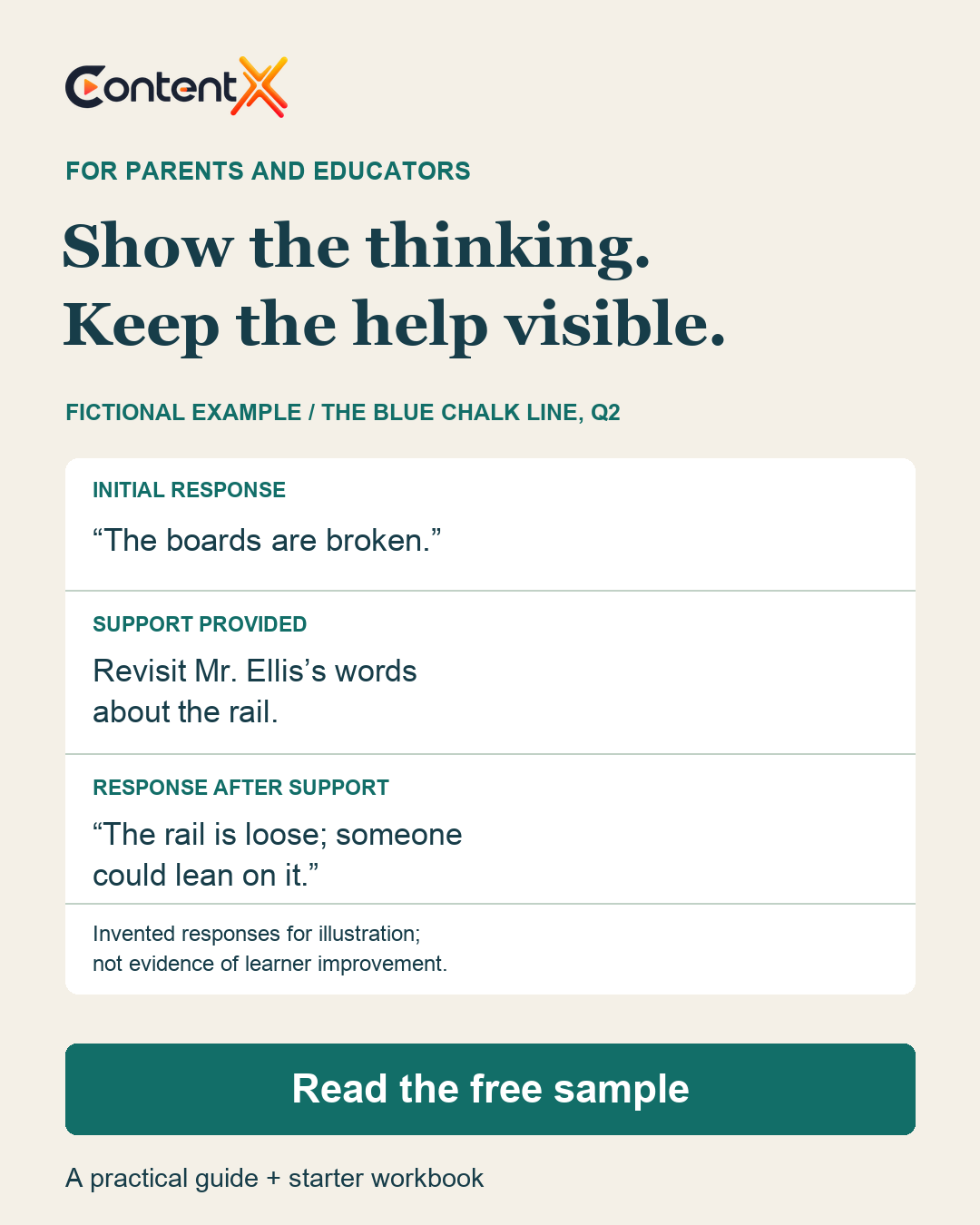
A Clearer Reading Conversation
What did the learner explain—and what help was needed? This guide makes that conversation concrete with original practice passages, twelve questions with answer keys, and printable planning and observation tools. Take a look at the sample from Listening with Purpose.
See the actual questions and tools.
CTA: Learn More
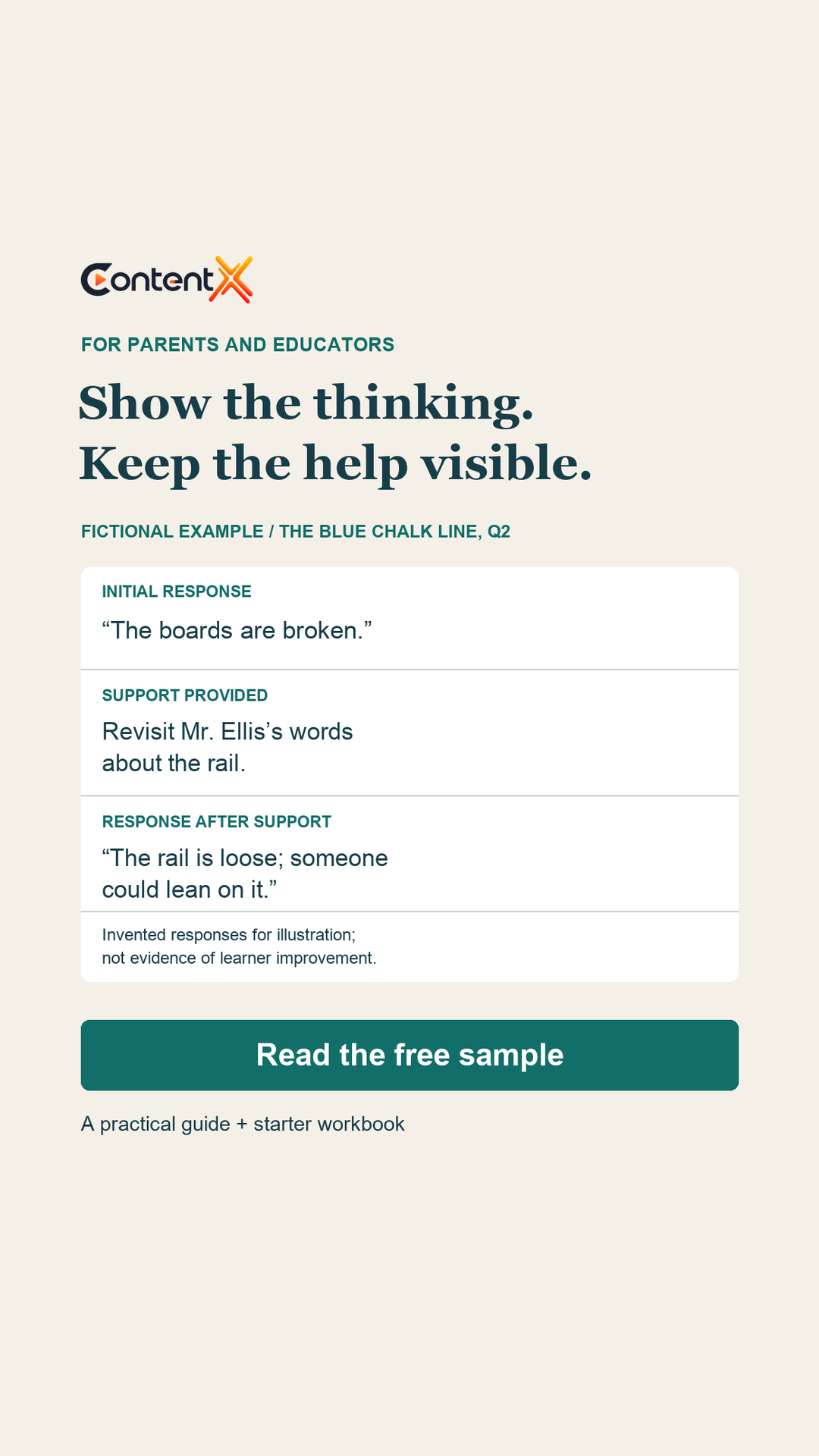
Measure the actual funnel.
- Give each creative and source its own UTM tags.
- Record landing visits and sample opens separately; a click is not a completed download.
- Verify checkout starts, paid transactions, secure delivery, and refunds in commerce records.
- Calculate realized acquisition cost and contribution from orders, not clicks.
- Stop for broken checkout/delivery, claim mismatch, or budget-control failure. Stop each channel at its own authorized total: $100 Meta and $70 Google Search. No automatic renewal or budget increase.
Ads may receive unequal delivery. This small test gives directional learning, not a conclusive A/B result. Stop/review checkpoints are manual; no persistent autonomous monitor is claimed. Actual platform lifetime and campaign caps are configured. This S3 preview has no tracking pixel. The external checkout/clean confirmation implementation offers optional Meta and Google measurement after consent, with Purchase metadata gated on verified payment. Genuine buyer delivery and consented Meta Purchase receipt/attribution remain unobserved; real buyer transactions will establish them. The user authorized the capped pilot after technical validation. Pause immediately for payment, entitlement, privacy or delivery failures.
Can a $12 book pay for cold ads?
Actual store/PayPal fees are not yet verified, so there is no established base-case margin. The scenarios expose assumptions. The book may earn nothing, including a full loss of the separate $100 Meta and $70 Search allocations ($170 combined). The scenarios below model the $100 Meta pilot alone; Search spend is additional and is not deducted in these tables. This is not a predicted earnings range.
Published PayPal fee sensitivity
PayPal’s US merchant fee schedule (updated November 4, 2026; checked November 14 UTC) lists domestic PayPal Checkout at 3.49% + $0.49 USD. This is a published-rate sensitivity, not the verified seller tariff. Country, payment type, international transactions, currency conversion, and negotiated terms may change the charge.
At the $12 price, this rate plus the assumed 5% gross refund reserve leaves $10.4912 per order before labor, tax, hosting, and other costs. Ten orders would cover the $100 pilot, leaving $4.91; this arithmetic assumes ten paid orders and does not predict them.
| Published-rate sensitivity | Expected orders | Gross | After assumed fees, reserve + $100 ads |
|---|---|---|---|
| Low response: $1.25 CPC / 0.5% purchase rate | 0.40 | $4.80 | −$95.80 |
| Middle assumption: $0.75 CPC / 1.5% | 2.00 | $24.00 | −$79.02 |
| Strong response: $0.40 CPC / 4% | 10.00 | $120.00 | $4.91 |
Your CPC and ROAS targets
A $0.25 CPC is a planning target under the $100 hard cap; it is not an extra $0.25 auction bid on the Purchase campaign. At $0.40 CPC and 4% purchase rate, $100 buys 250 modeled clicks and 10 modeled orders: $120 gross,120% gross ROAS. At $0.25 CPC and 4%, 400 modeled clicks produce 16 modeled orders: $192 gross,192% gross ROAS. Seventeen attributable paid orders produce $204 gross and 204% ROAS. None is guaranteed; zero sales remains possible.
Alternative stress test
Fee stress test: an illustrative 12.9% + $0.80 per order, plus 5% of gross reserved for refunds, leaves $9.052 per $12 order before labor, tax, hosting, and other costs. Twelve orders cover $100 ads. This is not the actual ContentX or PayPal tariff.
| Illustrative paid case | CPC / purchase rate | Expected orders | Gross | After stress-test costs + ads |
|---|---|---|---|---|
| Low response | $1.25 / 0.5% | 0.40 | $4.80 | $-96.38 |
| Middle assumption | $0.75 / 1.5% | 2.00 | $24.00 | $-81.90 |
| Strong response | $0.40 / 4% | 10.00 | $120.00 | $-9.48 |
Chosen inputs, not CPC/conversion benchmarks. Fractional orders are model expectations, not observed sales.
What organic distribution could change.
| 90-day hypothetical visits | Purchase rate | Orders / gross | After stress-test costs + one $100 pilot |
|---|---|---|---|
| 500 | 2% | 10 / $120 | $-9.48 |
| 1,500 | 3% | 45 / $540 | $307.34 |
| 4,000 | 4% | 160 / $1,920 | $1,348.32 |
No existing traffic or audience has been measured. The $100 is deducted once, not monthly. Labor, support, tax, hosting, affiliate commissions, and additional tools are excluded.
Change the assumptions.
The initial inputs illustrate the published US domestic PayPal Checkout rate; they do not assert the seller’s actual tariff. Replace them once verified. Use 12.9% and $0.80 to reproduce the alternative stress test above.
Refund reserve: assumed 5% of gross. This calculator cannot launch ads or change any account budget.
Published artifact evidence
Published illustrated99-page PDF:16figures,7sources. Selected144.0128-minute Ruth generative audiobook has12tracks and verified protected MP3 delivery availability. Complete paid PDF and audio remain outside the public preview prefix.
Public checks: Final selected-GENERATIVE site HTTPS readback verified all referencedHTML/sample assets against localSHA256; actual89.470454s content and75.88s story excerpts plus transcripts. Checkout and policies returned200 with12USD PDF+MP3 entitlement. See dated data/public-http-validation.json. No genuine payment or private full-file public request was made.
Private book protection: 2026-11-14T04:25:44Z: final contrast-corrected paid PDF and cover-only-remuxed generative MP3 verified through protected delivery with actual Range206, correct format headers and matching metadata SHA; anonymous requests403. Private/no-store. No paid transaction or Purchase event performed.
Browser checks: Actual final Chrome playback verified selectedGEN89.470454s content and75.88s story clips with no media errors.390px viewport/document widths both390; no horizontal overflow. Chrome and Codex in-app browser rendered all four production PayPal card fields plus wallet. No payment submitted; eligibility is session-specific.
What the capped launch will establish.
- Copy: plant/shelter mismatch corrected; starter-workbook scope explicit.
- Usability: inspectable sample, quick start, passage-selection checklist, and printable tool.
- Commerce: live $12 PayPal approval checkout is connected. Unpaid and forged requests are denied. The complete PDF+MP3 is protected and available after verified payment. Genuine paid purchases, buyer fulfillment and Purchase receipt remain unobserved; no synthetic sale is counted. The user authorized the capped pilot after technical validation.
- Ads: intended advertiser identity and account, USD billing, assets, destination, and a shared $100 Meta lifetime pool plus a separate $70 Search total cap.
- Scale: observed buyer feedback and net contribution. An AI score alone cannot approve scaling.
The full paid book is not public in this build. Source revision: ac4944c980af31dbe60857eb467a4ef57213d39f. New public assets do not turn skipped native stages into executed ones.