Choose the goal.
Then the format.
A practical guide for parents and educators choosing audio, print, or both. Work through examples, ask better questions, and keep track of the support a learner needs.
Preview before deciding. Research-informed guidance with a targeted 2023–2026 update, original teaching examples, and 16 explanatory figures.
Hear the ideas.
Then hear the story.
Two actual excerpts from the selected Ruth generative master, narrated with an AI voice from Amazon Polly. The first introduces the guide; the second reads its original fiction. Listen for yourself before deciding.
Chapter 1 · The learning goal
89 seconds · Ruth AI narration · selected generative master
Download excerpt · Read the excerpt · Clip details
Read the exact excerpt
“Does listening count?” sounds like a request for a simple verdict. A parent may actually be asking whether a child understood a story. A teacher may be asking whether an assignment demonstrated independent word reading. A learner may be asking whether enjoying an audiobook is a legitimate way to spend time with books. Those questions concern different things. We can answer each more usefully once we stop expecting a single judgment about format to settle them all. The first step is to name the learning we want to see.
Consider this fictional example, introduced to make the choices concrete rather than to report a real family. Eight-year-old Maya wants to join a class conversation about a long adventure story, but reading its chapters independently is currently difficult. She can explain complicated events she hears, yet works slowly through unfamiliar printed words. Her teacher can give her audio access to the adventure and continue teaching her to read suitable printed text. The two activities serve different purposes. Neither has to become a judgment about Maya's intelligence or effort.
Understanding language and reading words.
Understanding a spoken sentence and recognizing its written words are related accomplishments, but they are not interchangeable. A child might explain why a character hid a key after hearing a passage while being unable to read the word “cupboard” independently.
Original fiction · The Blue Chalk Line
76 seconds · Ruth AI narration · selected generative master
Download excerpt · Read the excerpt · Clip details
Read the exact excerpt
Tuesday afternoon, Nia found a blue chalk line across the entrance to the small footbridge behind the library. A cardboard sign read, “Please use the long path today.” Beyond the line, Mr. Ellis knelt beside the bridge with a toolbox. Nia had promised to bring a paper windmill to her little brother before his club finished. The long path went around the pond, and she was already late.
“Could I just run across?” she asked. “I hardly weigh anything.”
Mr. Ellis lifted one end of a wooden rail. A nail slid out and landed beside his shoe. “The boards underneath are sound,” he said, “but this rail is loose. Someone could lean on it without noticing.”
Nia looked at the pond. The water was shallow near the bank, but she knew the bridge crossed a deeper channel in the middle. She put the windmill carefully inside her bag and turned toward the long path.
Then a gust blew the cardboard sign flat. A delivery rider came around the library corner, looking at the boxes strapped to his bicycle. The blue line was almost hidden beneath a scatter of leaves. Mr. Ellis was holding the rail with both hands.
Nia stepped onto the path and waved.
The $12 bundle includes the complete PDF and one MP3 audiobook file with 12 chapter markers.
144.0 measured minutes in the full 12-track master. AI narration is disclosed; technical QC does not establish a full human listening study or an independent emotional-performance 9/10 score.
A real category.
A book-specific hypothesis.
People buy digital books.
AAP’s 2025 annual estimate reports $2.2 billion in ebook publisher revenue, up 3.2%. Its August 2026 participant report instead shows trade ebook revenue down 3.4% year to date. Demand is substantial; growth is uneven.
AAP annual report, August 10, 2026 · AAP monthly report, October 14, 2026. Annual estimates and partial-year participant reports use different scopes.
Direct purchase is established.
The Audio Publishers Association reports 2025 audiobook revenue of $2.43 billion, up 9%. In its 2026 consumer survey, 49% of past-year audiobook listeners reported buying from websites or apps. That is a listener behavior measure, not a share of revenue.
APA surveys, June 5, 2026. The same APA report says only 16% of audiobook listeners had tried AI-voiced audio and reported AI narration represented 0.03% of 2025 sales revenue. The public release has limited AI-definition and reporting coverage; this is not a universal market-share estimate. Reported willingness to try is not proof of paying demand. Category totals and overlapping purchase sources do not establish sales for this guide; inspect its actual audio sample.
The value must be visible.
The testable offer is saved planning effort for an adult already choosing audio and print: a connected decision guide, original exercises, reasoned answers and reusable records. Genuine willingness to pay $12 and profitable acquisition remain unobserved.
Free WWC comprehension guidance, September 2010 is a useful alternative. It does not endorse this book. Category demand is not book-specific sales evidence; zero sales remains possible.
See how a response becomes
a useful next step.
This short excerpt, Question 2 and its reasoned key are reproduced from the original workbook. The complete book has two original passages and 12 questions; this preview shows one small part.
The Blue Chalk Line — opening excerpt
On Tuesday afternoon, Nia found a blue chalk line across the entrance to the small footbridge behind the library. A cardboard sign read, “Please use the long path today.” Beyond the line, Mr. Ellis knelt beside the bridge with a toolbox. Nia had promised to bring a paper windmill to her little brother before his club finished. The long path went around the pond, and she was already late.
“Could I just run across?” she asked. “I hardly weigh anything.”
Mr. Ellis lifted one end of a wooden rail. A nail slid out and landed beside his shoe. “The boards underneath are sound,” he said, “but this rail is loose. Someone could lean on it without noticing.”
Try the question
Question 2. Why does Mr. Ellis keep people off the bridge even though the boards underneath are sound?
Reveal the exact answer and reasoning
Answer 2. The rail is loose, so someone might lean on it without realizing the danger. Mr. Ellis shows the loose rail and explains the risk. An answer saying the bridge boards are broken conflicts with his explicit statement that they are sound.
A filled record, with the help kept visible.
Fictional demonstration of the book’s observation template, created for this preview. These are invented example responses, not a real learner, a diagnostic result or evidence of improvement.
| Record field | Example entry |
|---|---|
| Goal and material | Explain why the bridge is closed, using one detail from The Blue Chalk Line. |
| Access arrangement | Adult reads the exact excerpt aloud; matching print remains available for a return to the text. |
| Initial response | “Because the bridge boards are broken.” |
| Support provided | Adult asks the learner to revisit Mr. Ellis’s words about the boards and the rail. The adult does not read out the answer key. |
| Response after support | “The boards are sound, but the rail is loose. Someone could lean on it.” |
| Next step and limit | Try a different short passage and record any support again. This single supported answer does not establish independent word reading or a general comprehension gain. |
The paid guide puts format decisions, original practice passages, answer reasoning and printable records in one place. The research itself is linked; free guidance is also available.
$12 USD · one-time purchase
Complete 99-page PDF with starter workbook and four printable tools, plus the complete chapter-marked MP3 audiobook: one MP3 file with 12 chapter markers.
Secure PayPal checkout; card options where eligible. Purchase, download and refund help · Contact ContentX. Purchase terms are available before payment.
What should the learner
be able to explain?
Name the task.
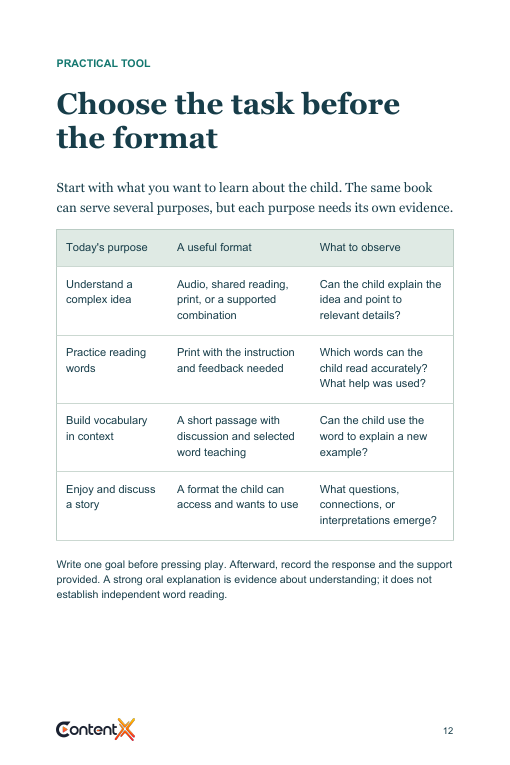
Understanding a story, practicing word reading, and learning vocabulary need different observations. Start with one clear goal.
Choose the support.
Compare audio, print, and combined use without treating a format preference as a fixed learning style.
Notice the response.
Keep the learner’s explanation separate from prompts, replay, or adult help. Use that record to choose a next step.
Guidance you can put on the table.
Read, try, and review.
The complete edition includes two original workbook passages, six questions for each, reasoned answer keys, worked parent–teacher cases, a five-session planning example, and printable observation forms.
The passages are starter materials, not a graded curriculum or standardized assessment. The value is a connected framework and usable examples in one place.
Chapter 1, a goal-selection tool, an observation record, and the book’s sources are included.
1. The Audiobook Question: Start with the Learning Goal
Separate the different decisions hidden inside the question of whether listening counts.
2. Understanding the Research Without Overstating It
Establish the identity and scope of the central research source.
3. Younger Readers: Open Access, Keep Teaching
Introduce the younger-reader finding without suggesting a universal or age-determined advantage.
4. Using Audio and Print Together
Establish the learning objective before selecting audio, print, or a combined arrangement.
5. How Listening and Reading Support Understanding
Distinguish understanding language from identifying written words.
6. Access, Instruction, and Different Starting Points
Keep learners’ knowledge and reasoning visible when selecting reading support.
7. What We Still Need to Learn
Separate immediate access to meaning from the longer-term development of independent word reading.
8. A Practical Routine for Home and Classroom
Distinguish the purpose of a session before choosing a reading arrangement.
9. The Long View: Progress, Transfer, and Adjustment
Define a revisitable progress question and a workable meaning of independence.
10. From Format Debate to Thoughtful Decisions
Synthesize the book into a concrete decision sequence before applying it to cases.
11. Practical Workbook: Passages, Questions, and Planning Tools
Set the scope of the original practice materials and explain how to record support.
Pictures with a job to do.
Sixteen original explanatory figures connect the research, worked examples, and workbook. Each has a caption and a text alternative in the reflowable editions.
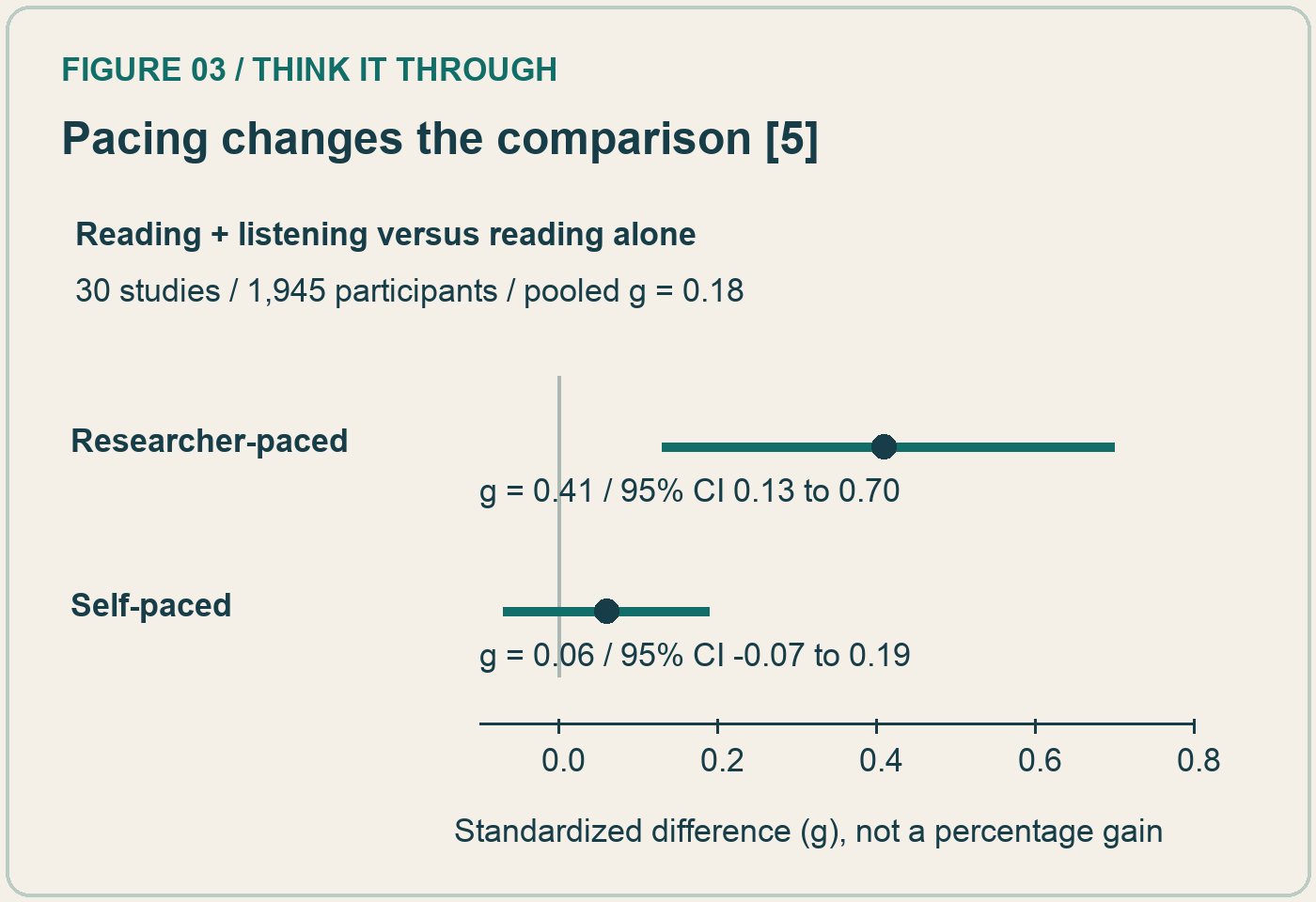
Pacing changes the comparison [5]
The 2023 meta-analysis compared reading while listening with reading alone. The pooled standardized effect was g = 0.18 across 30 studies (1,945 participants). Researcher-paced: g = 0.41, 95% CI 0.13 to 0.70; self-paced: g = 0.06, 95% CI -0.07 to 0.19. The self-paced interval crosses zero. These are group comparisons, not promised gains or proof that imposed pacing causes a benefit.
Open full-size figure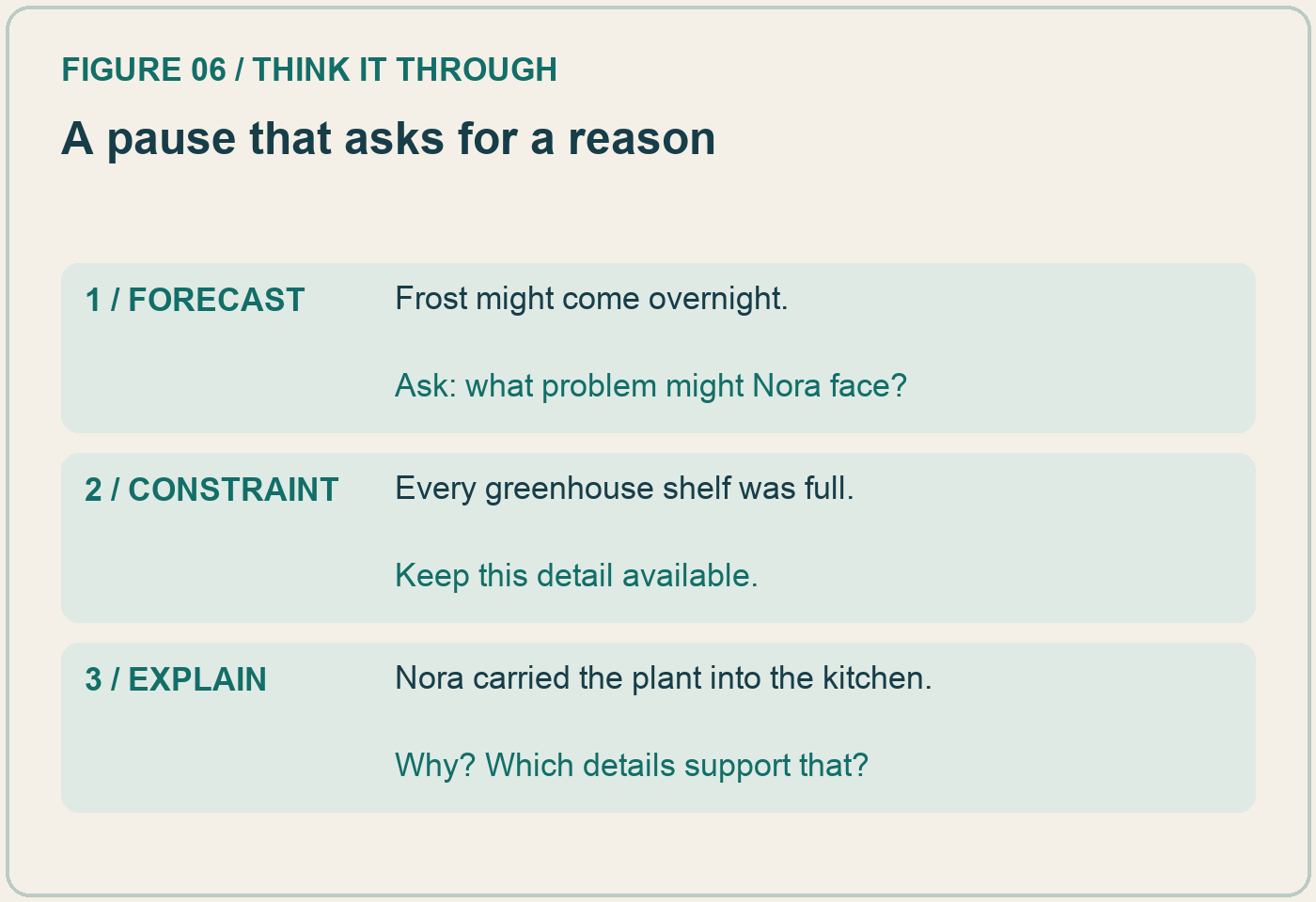
A pause that asks for a reason
Original teaching example: pause after the forecast of frost to ask what problem Nora might face. After the complete passage, ask why she moved the tomato plant into the kitchen and which details support that explanation. An optional pause supports thinking; it is not a tested schedule.
Open full-size figure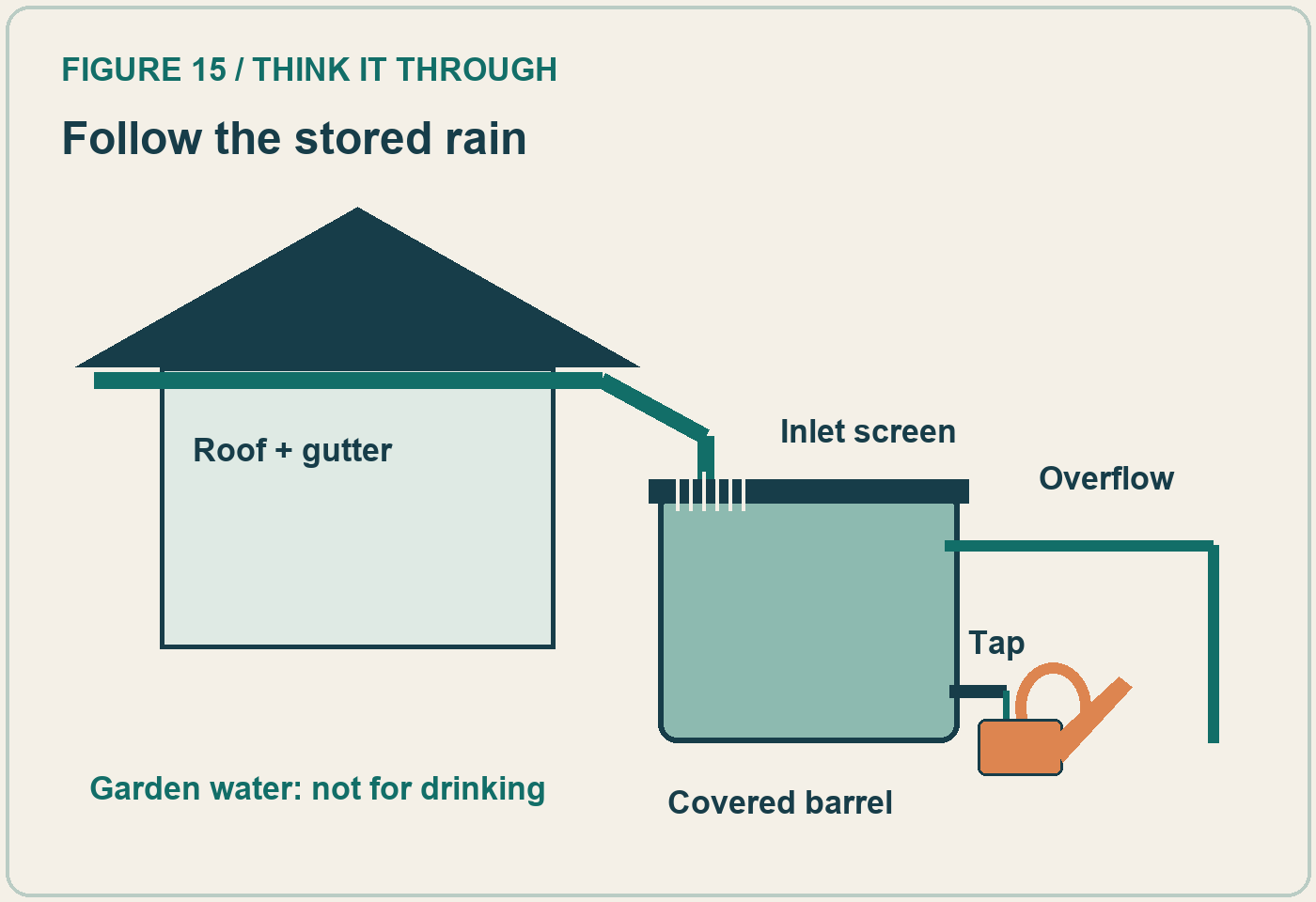
Follow the stored rain
Illustrative rain-barrel system: roof to gutter, inlet screen, covered barrel, tap and watering can; overflow routes extra water away. Garden water is not for drinking. This conceptual diagram is not installation guidance. Record whether this figure was available when using the questions.
Open full-size figureThe figures illustrate ideas and original teaching examples. They do not establish that this book is a validated intervention. The research update includes seven linked references and explicitly distinguishes audio, paired formats, and digital books.
Twelve chapters you can return to.
The complete 144.0-minute audiobook uses Ruth, an AI voice from Amazon Polly. The $12 bundle includes the PDF and one MP3 file with 12 chapter markers. The chapters cover ten chapters, the workbook and spoken explanations of the figures.
| Track | Chapter or companion | Current readiness |
|---|---|---|
| 1 | The Audiobook Question: Start with the Learning Goal | Ready in the chapter-marked MP3 |
| 2 | Understanding the Research Without Overstating It | Ready in the chapter-marked MP3 |
| 3 | Younger Readers: Open Access, Keep Teaching | Ready in the chapter-marked MP3 |
| 4 | Using Audio and Print Together | Ready in the chapter-marked MP3 |
| 5 | How Listening and Reading Support Understanding | Ready in the chapter-marked MP3 |
| 6 | Access, Instruction, and Different Starting Points | Ready in the chapter-marked MP3 |
| 7 | What We Still Need to Learn | Ready in the chapter-marked MP3 |
| 8 | A Practical Routine for Home and Classroom | Ready in the chapter-marked MP3 |
| 9 | The Long View: Progress, Transfer, and Adjustment | Ready in the chapter-marked MP3 |
| 10 | From Format Debate to Thoughtful Decisions | Ready in the chapter-marked MP3 |
| 11 | Practical Workbook: Passages, Questions, and Planning Tools | Ready in the chapter-marked MP3 |
| 12 | Audio companion to the illustrations and printable tools | Ready in the chapter-marked MP3 |
Chapter navigation and technical checks do not establish a human narrator, a full human listening study or a 9/10 emotional-performance score.
A quick-start route.
- Choose one goal: “Explain why a character changed a plan” is more useful than “finish a chapter.”
- Check suitability: choose a short passage the learner can access with needed support. Clarify essential language and context. Do not infer a reading age from these uncalibrated examples.
- Make the format usable: check audibility, text visibility, replay controls, comfort, and existing access arrangements.
- Ask, then record: keep the initial explanation and the help provided separately. Use an appropriate response or communication method.
- Choose a next step: try a related new passage, adjust one support, or discuss an instructional need with the person responsible for the learner’s plan.
Who it is for.
Parents, caregivers, tutors, and elementary educators who want a clearer conversation about audiobooks and a manageable way to observe understanding.
What to expect.
A practical synthesis and starter workbook. It does not provide diagnosis, a validated intervention, or promises of higher reading scores.
$12 USD · one-time purchase
Complete 99-page PDF with starter workbook and four printable tools, plus the complete chapter-marked MP3 audiobook: one MP3 file with 12 chapter markers.
Secure PayPal checkout; card options where eligible. Purchase, download and refund help · Contact ContentX. Purchase terms are available before payment.